


What is 3D DOOH? How 3D works on digital out-of-home screens
3D DOOH is creative built for one digital out-of-home screen so the image seems to leave it. How the illusion works, which screens can run it, real examples, cost and timing.
What is 3D DOOH?
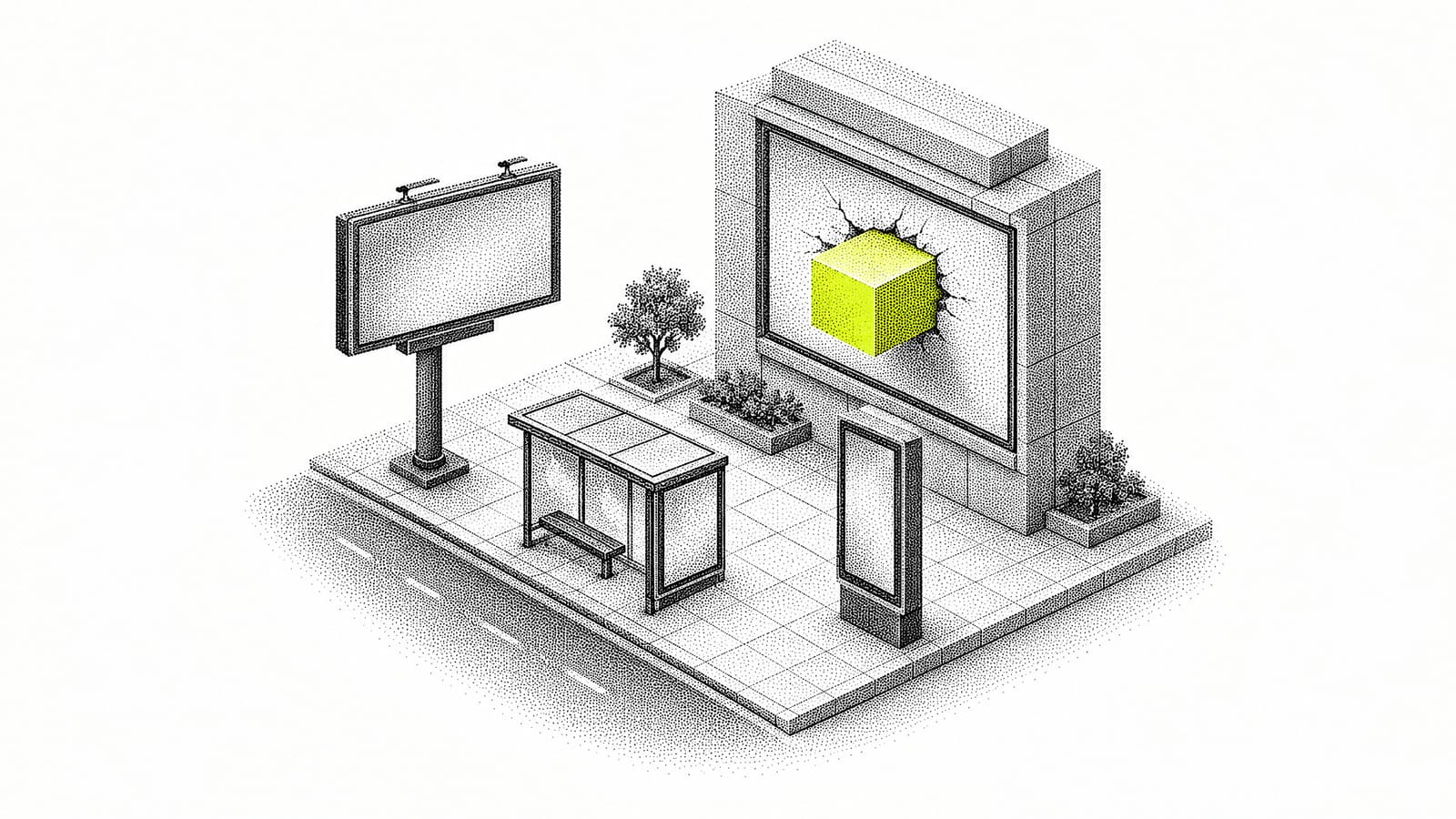
3D DOOH is creative built for one digital out-of-home screen so that, from where people stand, the image has depth and objects seem to leave the frame. It runs on ordinary LED screens in stations, malls and on buildings. No glasses, no special screen: the depth is in the film.
In short: DOOH is the medium, 3D DOOH is a kind of creative for it (also called an anamorphic billboard). The media buy stays the same. What changes is the film, and what people do in front of it.
First, what DOOH means
DOOH stands for digital out-of-home: ads on digital screens in public places, from roadside billboards to station, mall and building screens. Most screens play a loop shared by several advertisers, and the files can change by the hour. Our guide What is DOOH? covers the meaning, the screen types, how it is bought and how it is measured.
For 3D, one buying detail matters. Programmatic DOOH buys impressions across many screens, while a 3D film is built for the exact shape of one screen, so you need to know in advance which screens will play it. In our experience, 3D DOOH is bought direct, on named screens. If nothing is booked yet, we can handle the media buy: you keep control of the budget, and the screens are picked to fit the idea. What the media itself costs is explained in how much DOOH advertising costs.
How 3D DOOH works: the anamorphic illusion
3D DOOH (also written 3DOOH, and called 3D OOH, a 3D billboard or an anamorphic billboard) is a creative technique, not a type of screen. The screen is an ordinary LED screen. The depth comes from how the film is built.
The scene is made in 3D software, with the screen treated as a window or the open side of a box. It is then rendered from one point: the spot where the crowd stands. From there, the perspective of the virtual scene lines up with the real building, and the eye reads depth. A product can sit “inside” the building and lean out over the street.
Three things follow:
- It works from one zone. Step far to the side and the image stretches. The illusion is designed for a viewpoint, so the viewpoint is the first thing to check.
- It needs the real geometry. Size, pixel map, corner angle, height above the street. A spec sheet is not enough: we also need a photo from where the crowd stands.
- It needs motion. Depth reads best when things move: an object crossing the edge of the frame, shadows that shift.
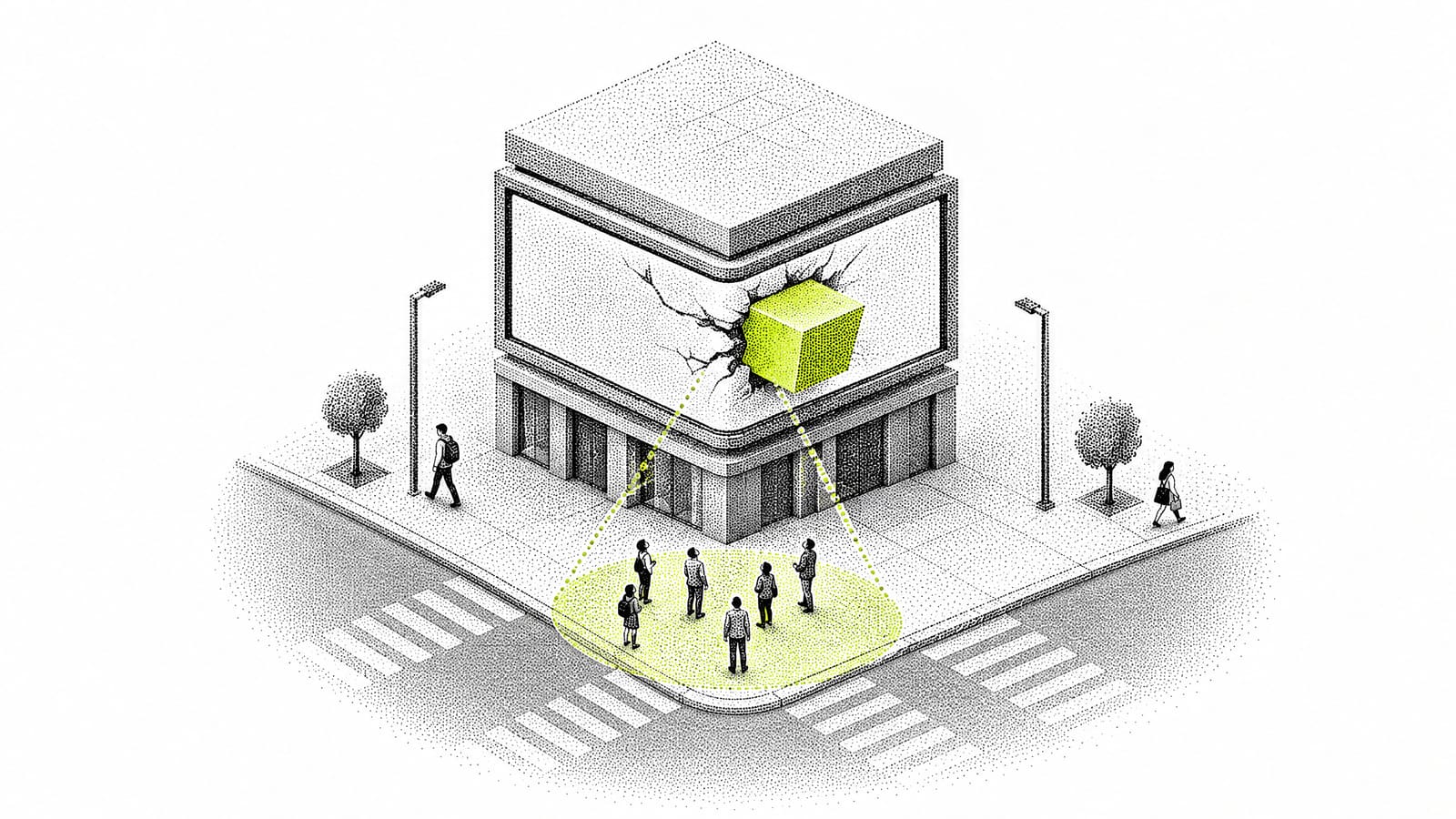
How anamorphic billboards work goes further into the geometry, the light and the loop.
Which DOOH screens can run 3D
Three screen shapes work, each in its own way.
Corner screens. Two faces meeting at an angle, usually on the corner of a building. The scene is built as a box whose inner corner matches the real one. This is the strongest version. Corner screens are rare and get booked well ahead.
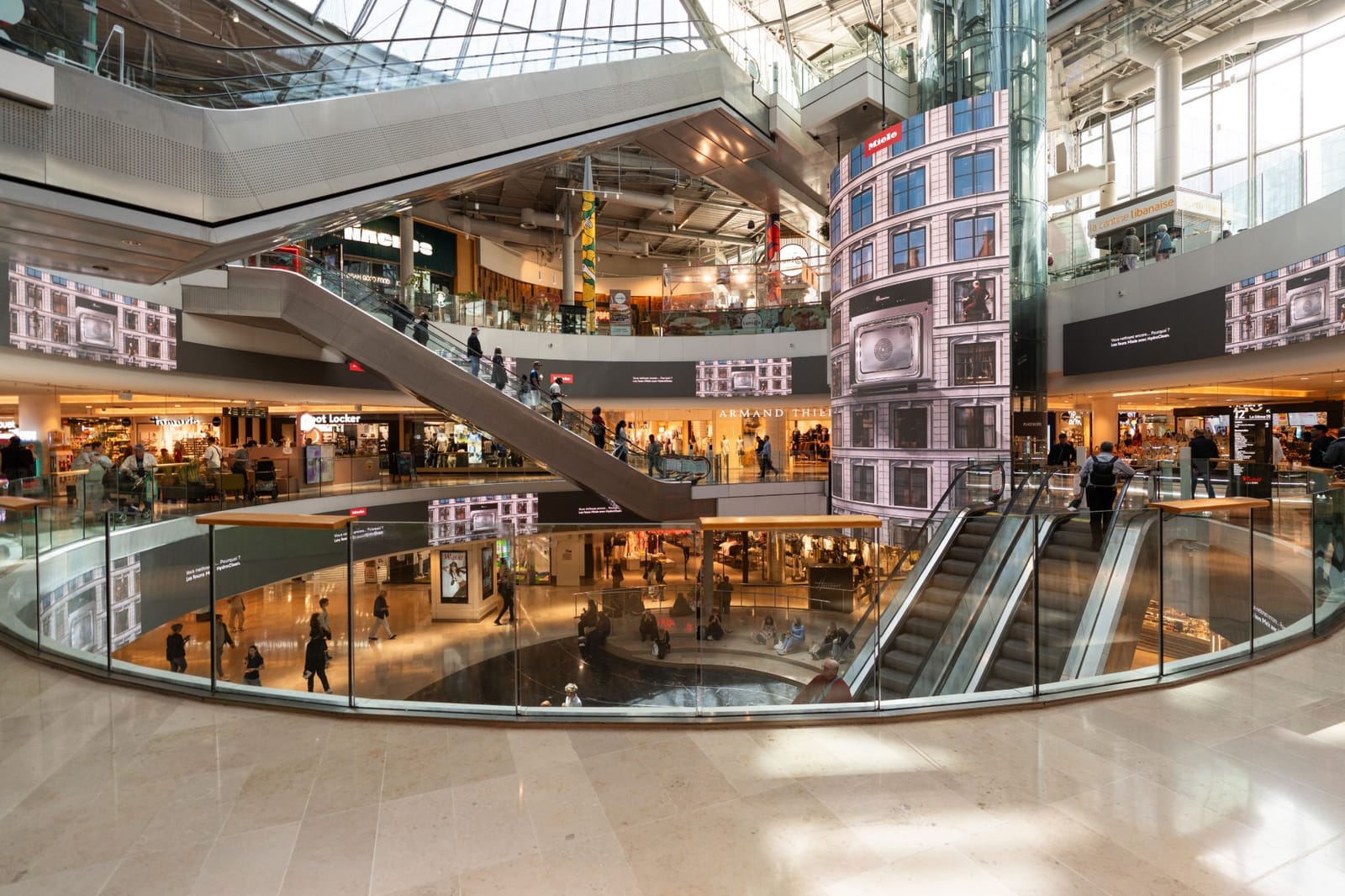
Curved screens. A screen that wraps around a facade or a pillar. A curve carries depth well when the viewpoint is known, like the cylindrical screen in the Miele example below.
Flat screens. Most of the inventory: facades, station panels, mall screens, portrait and landscape. The effect uses a frame drawn inside the screen, depth behind it, and a product that crosses the frame. It is softer than a corner, and it runs on far more screens, which is what makes a network campaign possible.
Our guide to corner screens and flat screens helps you choose. What rules a screen out: a static-only rule, low resolution, no place where people stand, or a viewing area so wide that few people see the right angle. The screen brief checklist lists what to ask the media owner before anything is built.
Why brands add 3D to a DOOH plan
People stop. A flat ad is seen in passing. A screen that seems to open makes people stop, point and wait for the loop to come round.
People film. This matters most. Every phone raised in front of the screen makes content the brand did not pay to distribute, and it reaches people who never walk past. Plan for it: the brand’s own cut and a FOOH version for social reuse the same 3D scene.
The media stays the same. You book the same screens at the same rates. The extra cost is in the creative.
Be careful with the numbers you read online. Independent research on anamorphic 3D is thin, and most “3x more dwell time” figures come from vendors that publish no method. We do not quote them. Our own campaigns add up to 3B+ earned and owned media, much of it from our FOOH films.
The honest limits: the illusion works from one zone, the novelty has worn off in the big cities (a 3D effect alone no longer guarantees that people film it: the idea has to earn it), and nobody can promise a campaign will go viral.
3D DOOH examples
Miele HydroClean (KOSMO, 2026). One CGI idea for Miele’s self-cleaning oven: a European building that opens like an oven and cleans itself. It ran on 81 DOOH screens in 76 cities across France, Belgium, Luxembourg and the Netherlands, in 5 languages and more than 300 versions, mostly in 10-second slots in malls, stations and shopping streets. It shows 3D built for a whole network, not a single landmark.
WAVE by d’strict, Seoul (2020). A giant wave that seems to crash inside a glass box on the COEX building in Gangnam, on a screen about 80 m wide that wraps the facade, by the Seoul studio d’strict (designboom). Public media art rather than an ad, and still the reference most people cite.
The Shinjuku cat, Tokyo (2021). A giant 3D calico cat on the curved 4K screen of the Cross Shinjuku Vision building, opposite the east exit of Shinjuku Station, in full operation from July 12, 2021 (Time Out Tokyo). It was created to promote the screen itself, and it drew crowds to the east exit.
The last two are other studios’ work. For more famous 3D billboard examples by city, see where 3D billboards work best.
How much does 3D DOOH cost, and how long does it take?
Media. The same rate card as any booking on that screen. Landmark screens cost more because they are landmarks, not because the creative is 3D.
Creative. There is no fixed price per anamorphic asset. It depends on the resizing, the number of screens and formats, and the complexity of the scene: fur, liquid, glass and crowds take render time. The projects we are built for usually land around €40,000. Each extra screen costs less than the first, because the idea, the models and the animation already exist. Our 3D billboard cost guide breaks it down.
Time. 3 to 4 weeks from the approved brief to delivery, with two rounds of changes included. Add the media owner’s approval window, and book early if you want a corner screen. The production timeline shows each step.
FAQ
Can 3D DOOH be bought programmatically?
Rarely. A 3D film is built for one screen’s exact shape and viewpoint, so it has to know where it will play. Programmatic buying suits flat creative across many screens; 3D is booked direct, on named screens.
What is the difference between 3D OOH and 3D DOOH?
Most people use both for the same thing: anamorphic creative on a digital screen. Strictly, 3D OOH can also mean a printed billboard with physical 3D pieces attached. 3D DOOH is always digital.
Do you need 3D glasses or a special screen for 3D DOOH?
No. It runs on a standard LED screen. The depth comes from the way the film is rendered for one viewpoint, so people see it with the naked eye from the right spot.
Can one 3D DOOH idea run in several countries?
Yes, if it is planned from the start. Miele HydroClean ran in 4 countries and 5 languages from one scene, with the text rebuilt in each language rather than pasted on top.
How do you measure a 3D DOOH campaign?
The media owner reports plays and estimated audience, as for any DOOH booking. On top of that, track reaction videos by location tag, hashtag and brand mention, and the results of the brand’s own cut and of the FOOH film.
Have a DOOH screen in mind?
Tell us about your screen: where it is, the dates and the product. We tell you whether it can carry 3D, which format fits and what it takes. Not ready to brief yet? Ask for a free concept for your screen and judge the idea first.