


Corner screen vs flat screen vs curved: choosing a 3D billboard format
Corner, flat and curved screens build the 3D illusion in different ways. How each one works, how strong it is, what it costs, and how one idea runs across all three in a network campaign.
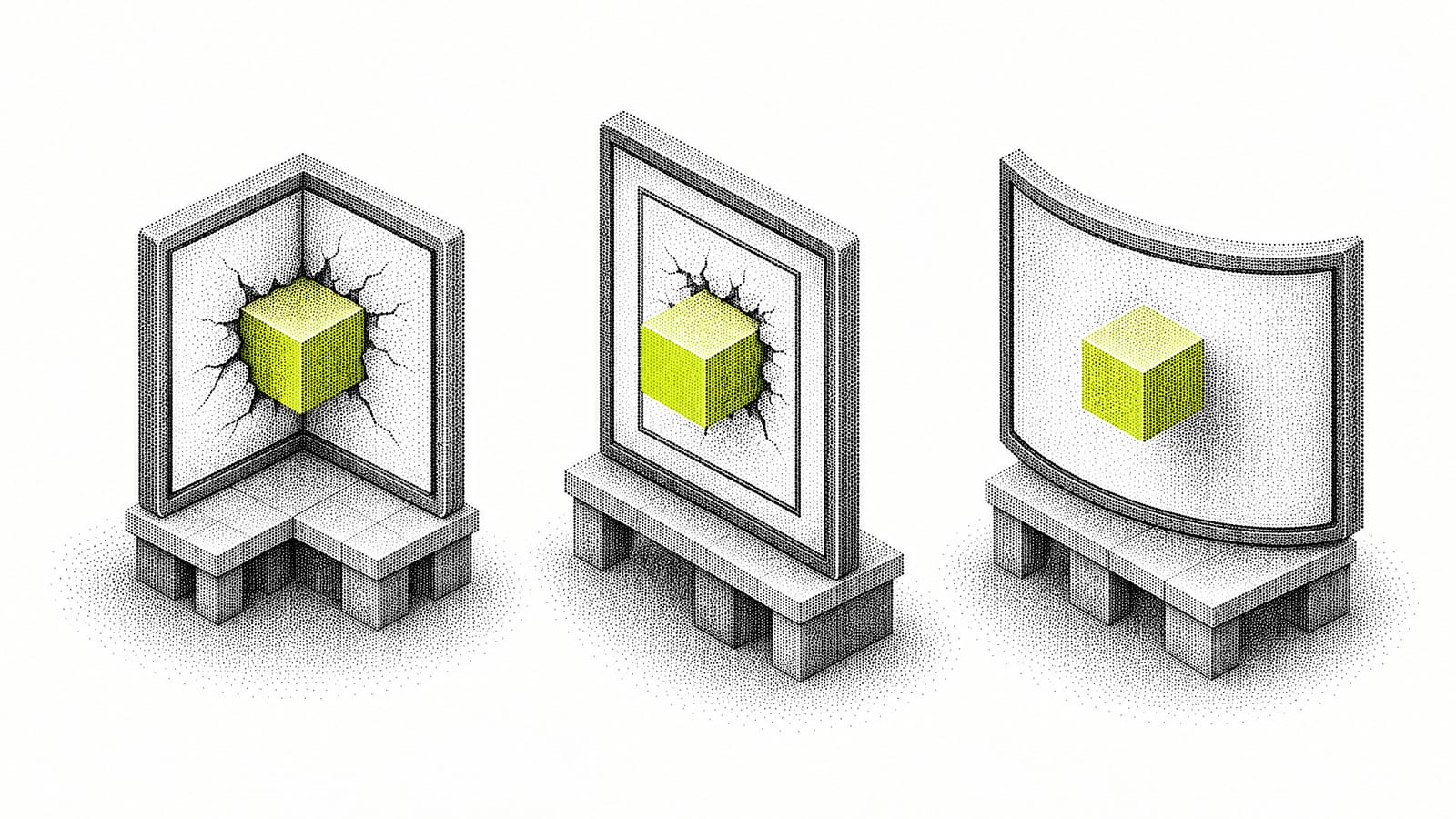
Corner screen vs flat screen: the short answer
A corner screen, two LED faces meeting at an angle, gives the strongest 3D billboard illusion: the scene sits inside the building and leans out. A flat screen gives a softer effect but covers most of the screens you can book. Curved screens sit in between. Choose the format from the screens in your plan, not from the idea.
Start from the screen, not the idea
The geometry decides how the illusion is built, how strong it gets and where people must stand. So every 3DOOH project starts with four things: the layout (one face, two faces or a curve), the real size and pixel map, a photo from where people stand, and the media owner’s specs.
For the illusion itself, start with how anamorphic billboards work.
Anamorphic vs forced perspective: is there a difference?
Both terms describe one principle: a 3D scene rendered for one viewpoint, so a flat surface seems deep. The industry uses them loosely.
- Anamorphic is used most for content built across a corner or a curve. The image is visibly warped across the faces and only resolves from the sweet spot.
- Forced perspective is used most for flat screens: a fake frame, a deep space behind it, and objects scaled and placed to trick the eye. The term comes from film and architecture, where it makes things look nearer, further, bigger or smaller than they are. The Lord of the Rings films used it to make hobbits look small next to wizards.
In production, the pipeline is the same: a digital twin of the site, a virtual camera at the viewer’s eye, a render projected back onto the screen. Only the geometry changes.
The corner screen (L-shaped LED screen)
How the illusion is built. Two faces meet at an angle, usually 90 degrees, on the outside corner of a building. They act like the glass walls of a display case set into the building, and the product leans out of it over the street.
Strength. The strongest version. From the right spot you see both faces at once, so the brain reads a volume without a drawn frame.
Viewing zone. Narrow. The sweet spot sits on the diagonal facing the corner, usually across a crossing or a square. The harder the corner, the tighter the zone.
Inventory. Rare. Corner screens usually sit on landmark sites, and they are priced like landmarks.
What to get from the media owner. The pixel map of both faces, the exact angle, how the seam between the faces is handled, and whether the two faces play one file or two synced files.
Cost and time. The scene is built around one building, so geometry work and tests weigh more per screen. Worth it for a hero moment.


The flat screen: a 3D effect without a corner
How the illusion is built. A frame is drawn inside the image: a border, an opening, the edge of a box. Behind it the scene goes deep. The product crosses the frame, and the brain places it in front of the screen. Shadows and light that match the site do the rest.
Strength. Softer, because the frame does the work a corner does for free. Done well, it still stops people.
Viewing zone. Wider: anywhere in front of the screen. Because flat screens are seen from many angles, the film must also work as a good 2D film.
Inventory. Most premium digital out-of-home is flat: mall and station panels, landscape screens, facades, airports. That is what makes a 3D network campaign possible.
Cost and time. One master scene adapts to many flat screens, so the cost per screen drops with every screen you add.
Curved LED screen 3D content
Curved screens behave like a soft corner: the scene wraps without a hard edge.
The Shinjuku cat in Tokyo ran on a screen with a rounded corner. Sixteen:Nine noted that the illusion still only works from a specific angle off that corner. WAVE, by the Korean studio d’strict, ran on a screen about 80 meters wide that wraps around the COEX Artium in Seoul.
To create 3D billboard videos for curved screens, get three things right:
- The exact curve. Radius or angle, where the curve starts and ends, and the panel layout.
- The gaps. Ocean Outdoor’s spec sheet for The Curve on Leicester Square in London describes a central screen made of 36 sections with gaps of about 16 pixels between them. Nothing vital can sit behind a gap.
- One side. The same spec sheet recommends building anamorphic content for one side of the curve only, because most people see one side or the other.
On columns and cylinders, the image wraps all the way around, so the illusion is built for the main approach.
Corner vs flat vs curved: decision table
| Corner screen | Flat screen | Curved screen | |
|---|---|---|---|
| Strength of the illusion | Strongest | Softer, depends on the frame | Strong, often on one side |
| Viewing zone | Narrow, on the diagonal | Wide, in front | One side or the main approach |
| Inventory | Rare, landmark sites | Most premium screens | A few landmark screens, mall columns |
| Production effort per screen | Highest | Lowest once the master exists | Medium to high |
| Best for | A hero launch moment | Reach across a network | A landmark moment |
Screen size and resolution for 3D
There is no minimum size. Two things matter more than the pixel count. For screen shapes and content in detail, see our guide to the anamorphic screen.
Physical size and distance. The scene is built in meters. A big screen seen from far away holds the illusion over a wider zone. A small screen seen up close needs a tight pixel pitch, or the pixels show.
The resolution of each face. Large screens rarely use standard sizes. Ocean Outdoor’s UK media walls run at sizes like 1512 x 324 or 4800 x 918 pixels, and the faces of one site can have different pixel pitches. After the HydroClean campaign, Miele’s media team drew the same lesson: only very high-resolution screens, each checked with the media agency. Our guide to DOOH specs for 3D content lists what to ask for.
One idea across every format: the Miele HydroClean campaign
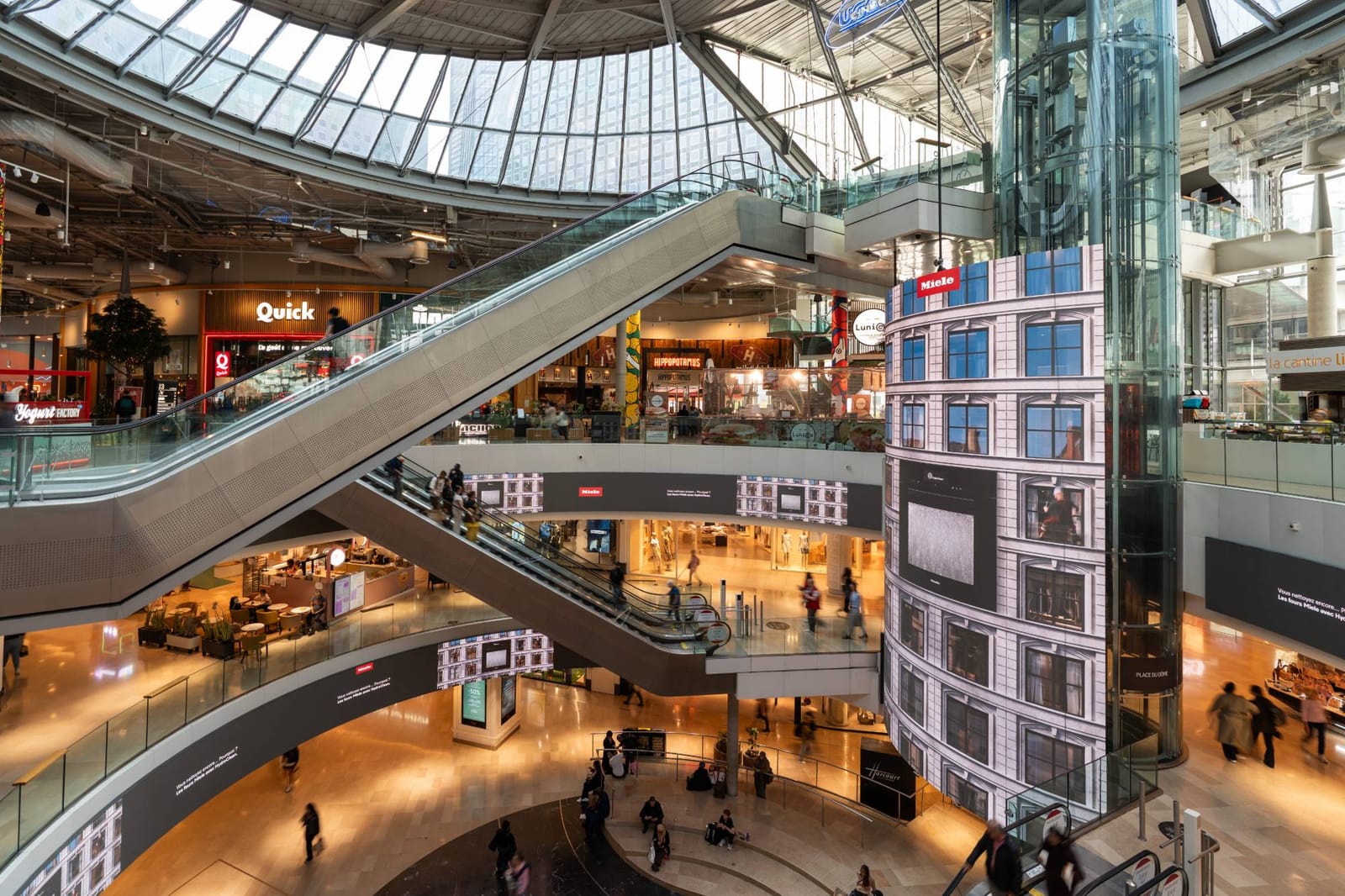
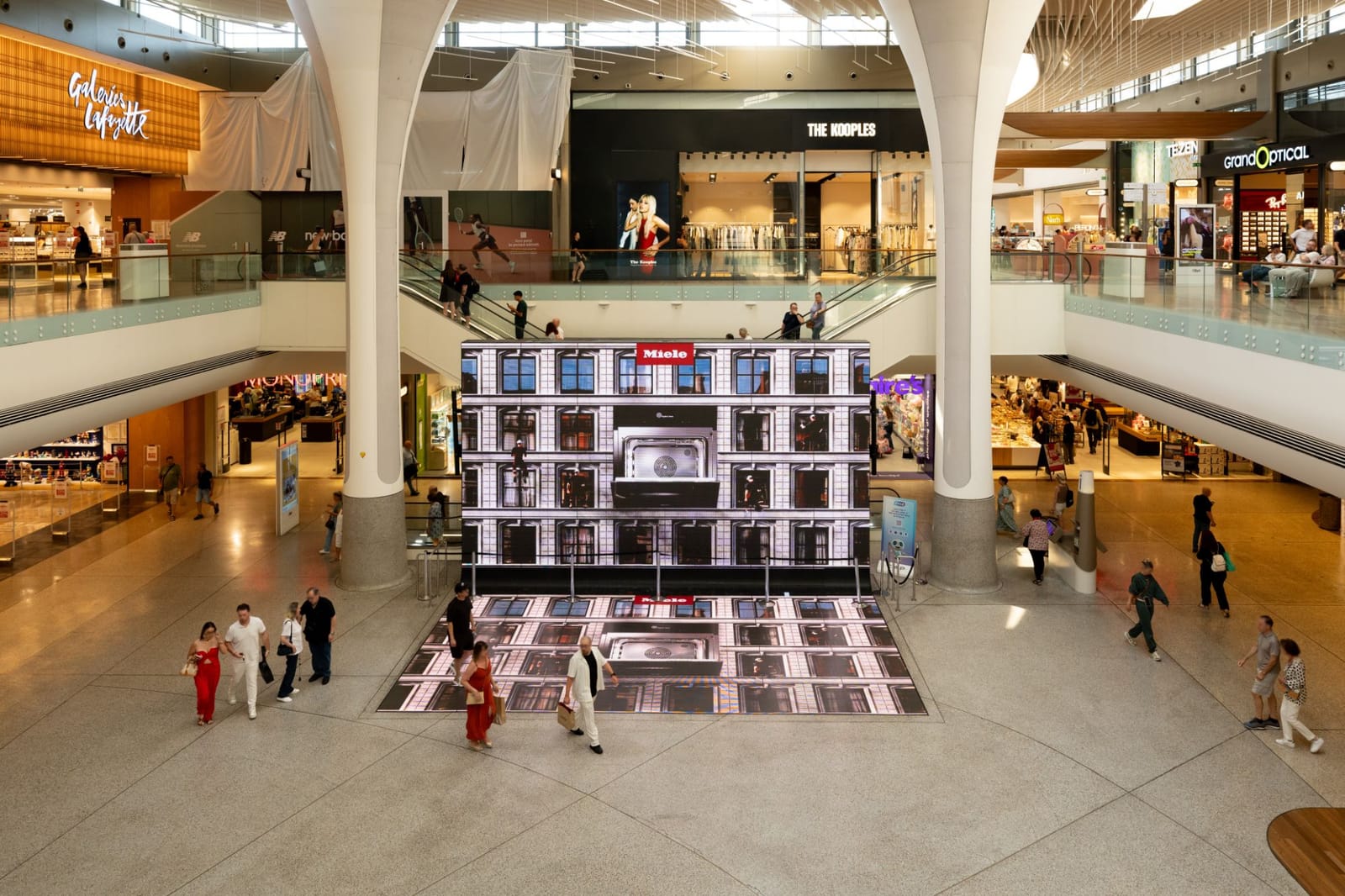
For the launch of Miele’s self-cleaning HydroClean oven, we built one CGI idea: a European facade that behaves like an oven. It ran on 81 screens in 76 cities, 4 countries and 5 languages, with more than 300 versions.
The idea was chosen to survive every shape: a building with square windows scales from a small mall screen to a whole facade. The scene ran on the cylindrical Digital Dream at Westfield Les 4 Temps, on the wide, flat Business Wall in the same mall, and on the LED wall and floor of the Cap 3000 atrium near Nice. Each screen got its own version for its layout, resolution and frame rate, and screens with blind spots, like an escalator, got a version with nothing important placed there.
What a network campaign takes from it:
- Design the idea for the hardest screen in the plan, then adapt.
- Build one master scene. Each format gets a new camera and a new render, not a new idea.
- Collect every spec sheet before the first render, with the screen brief checklist.
- Fix languages and ratios at the start.
FAQ
What is an L-shaped LED screen?
An LED screen with two faces that meet at an angle, usually wrapped around the corner of a building. It is the classic format for anamorphic 3D, because it shows the scene from two sides at once.
Can the same 3D video run on a corner screen and a flat screen?
No. Each geometry needs its own camera and its own render. The idea, the 3D models and the animation are reused, which is why adding formats costs less than the first screen.
Is a corner screen worth the extra cost?
When one landmark moment matters most and the corner sits where crowds stop, yes. When reach matters more, a network of flat screens does more for the same budget. Our 3D billboard cost guide explains what moves the price.
How do I find corner or curved screens in a city?
Ask the media owners for their landmark sites, or ask us: we can check a screen or handle the media buy for you. Our guide to the best cities for 3D billboards is a starting point.
Not sure which format your screen is?
Send us the screens in your plan through contact, with a layout and a photo. We tell you which format each one can take and how one idea runs across all of them. Want to see it first? Ask for a free concept for your screen.