


DOOH specs for 3D billboards: what to get from the media owner first
Resolution, codec, frame rate, spot length, file size, sound, content rules: the digital OOH specs to collect before a 3D production, typical values, and why files get rejected.
What are DOOH specs?
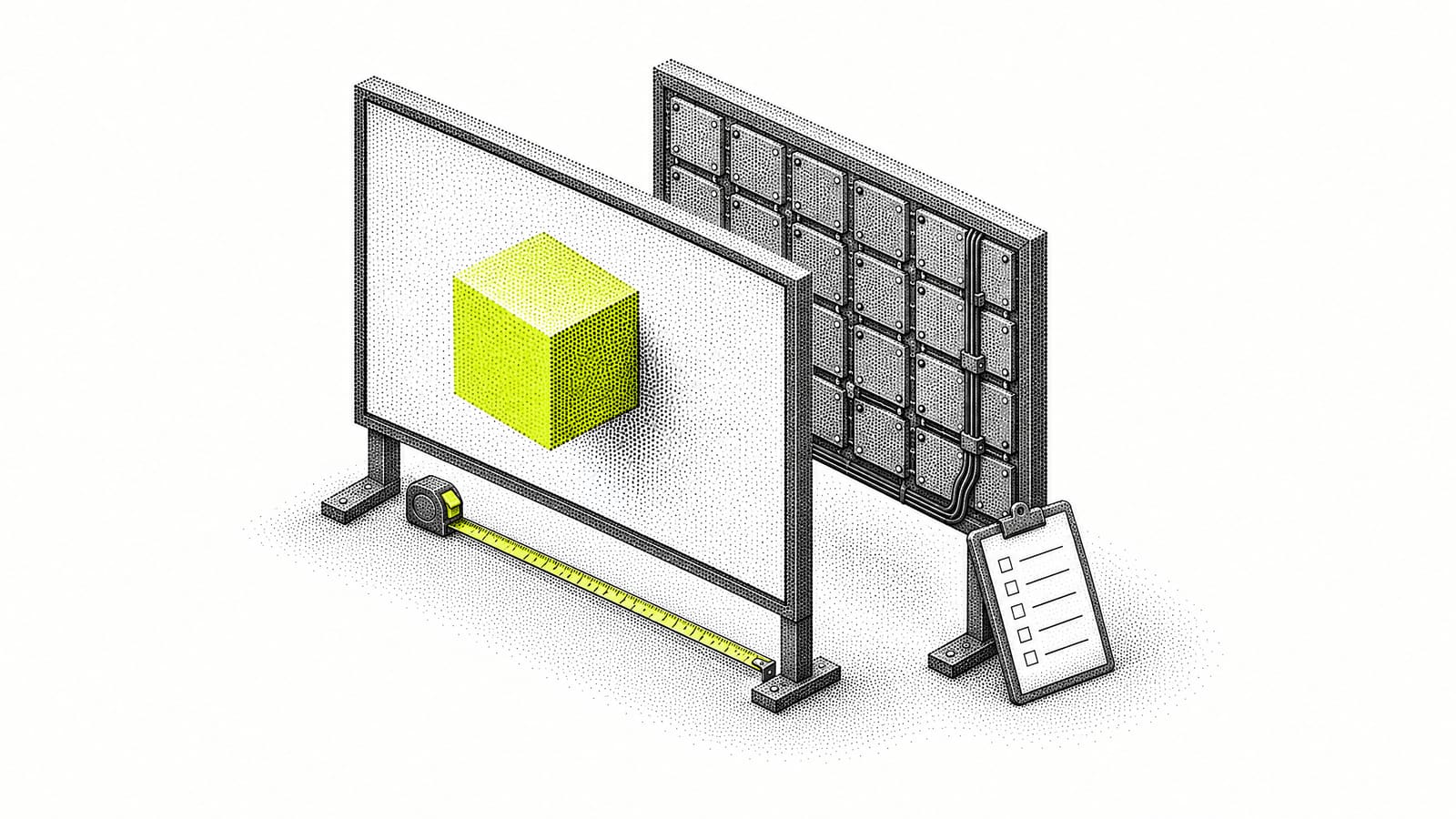
DOOH specs are the technical rules a media owner sets for each digital screen: pixel resolution, file format and codec, frame rate, bitrate, file size, spot length, sound and content rules. For a 3D billboard you also need the screen’s real dimensions, its geometry and a photo from the viewpoint. Get all of it before production starts.
There is no universal digital OOH spec. Each network, and often each site, has its own sheet. A file built to the wrong one gets rejected, or runs badly.
Typical digital OOH specs
The values below are typical, taken from published media-owner spec sheets. Always confirm them for your exact screen.
| Spec | Typical values | What to confirm |
|---|---|---|
| Resolution | 1920 x 1080 or 1080 x 1920; large screens often non-standard | The exact pixel size of each face |
| Video format | MP4 or MOV, H.264 codec | Whether H.265 is accepted |
| Frame rate | 25 fps in the UK and Europe, often 30 fps in the US | The exact rate |
| Bitrate | Around 8 Mbit/s, more on some premium screens | The cap |
| File size | Caps from 25 MB to 100 MB | The cap |
| Spot length | 6 or 10 seconds on many networks, up to 30 on some | Length and share of loop |
| Sound | Usually none | Whether the site has speakers |
| Color | RGB, never CMYK | The color space |
| Delivery | About 5 business days before launch | Deadline and approval time |
What the sheets actually say:
- Bauer Media Outdoor (formerly Clear Channel UK) asks for MP4 or MOV in H.264 at 25 fps, 8 Mbit/s and 25 MB at most on its Station Live screens, with a standard 10-second slot and no sound.
- Ocean Outdoor’s UK spec sheets ask for H.264 at 25 fps, a bitrate up to 8 Mb/s, no audio, a 10-second spot, and artwork at exactly the stated pixel size, 5 business days before launch.
- JCDecaux UK takes MP4 for motion and JPEG for static, up to 100 MB, uses 6-second spots on its rail digital 6-sheets, and runs no motion copy on roadside formats.
- In the US, Lamar says two sizes, 1400 x 400 and 840 x 400, reach over 90% of its digital billboards, which rotate every 6 to 10 seconds. QR codes are not allowed.
Some premium screens accept 30 or 60 fps, H.265 or longer spots. Ask; never assume.
The 3D items no spec sheet gives you
A standard sheet is written for flat 2D ads. A 3D billboard needs more:
- A photo or video from the viewpoint. At eye height, from where most people stand, by day and by night. Note poles, trees, signs and reflections in the way.
- Real dimensions. Width and height in meters, height above the ground, distance to the viewing zone. The 3D scene is built at real scale.
- The geometry. The angle of a corner, the radius of a curve, which face is which. Our guide to corner, flat and curved screens explains why each shape needs a different build.
- The pixel map. See below.
- Sync between faces. One file split by the player, or one file per face. Ocean’s sheet for The Curve on Leicester Square asks for separate files for each of its three screens, all of exactly equal length.
- The recommended viewpoint. Some media owners say where the 3D works. The same sheet recommends anamorphic content for one side of the curve only.
- Blind spots. Escalators, window frames, columns. On the Miele HydroClean campaign, screens with blind spots got a version with nothing important placed there.
- A test slot. A few minutes on the real screen before launch, if the media owner allows it.
What is a pixel map?
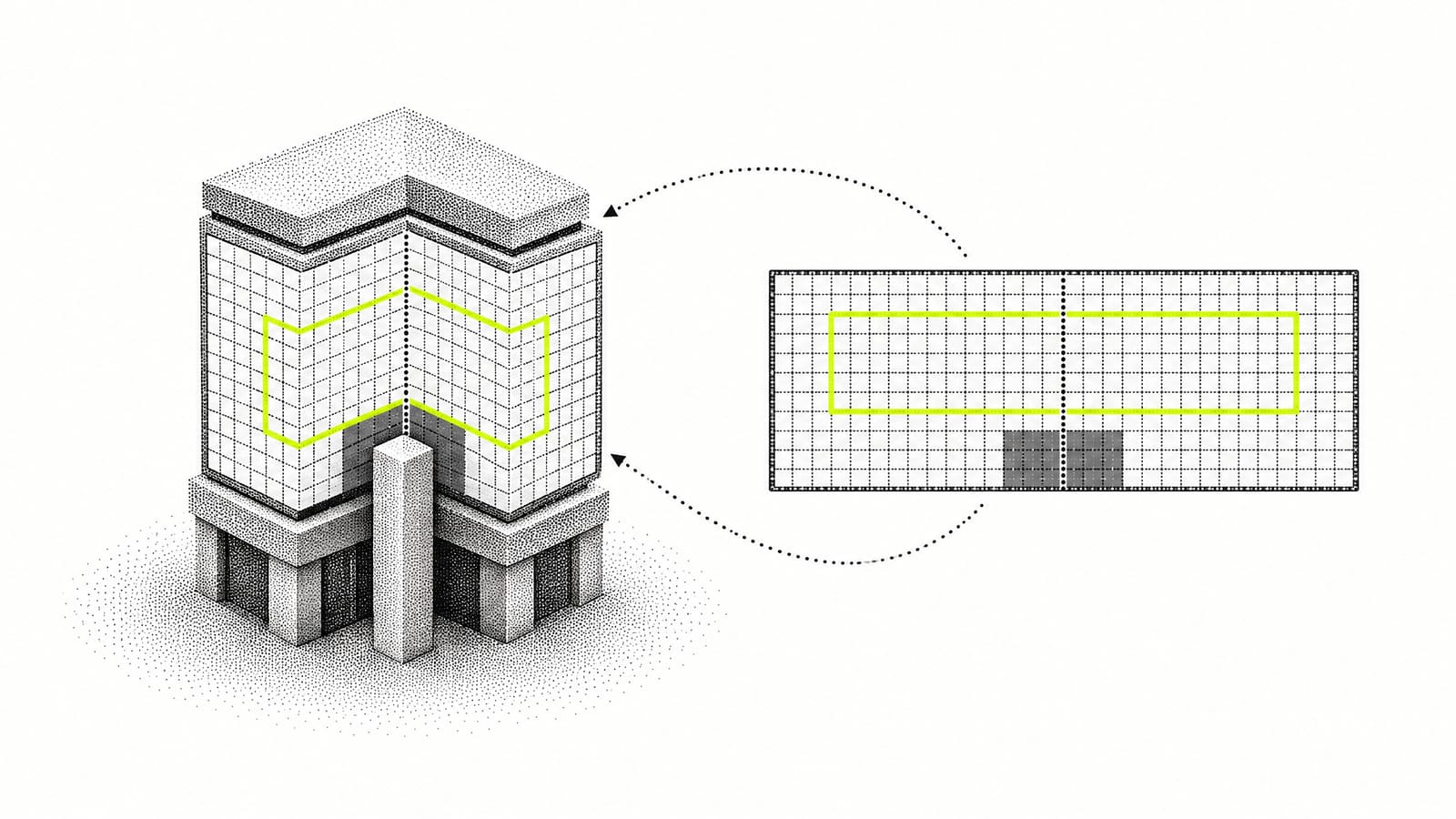
A pixel map is the drawing of how a screen’s pixels are laid out: each face and its resolution, where the faces meet, the gaps between panels, dead zones, and how the delivered file is split across the faces.
It matters more for 3D than for anything else. A flat ad survives a few pixels of error. A 3D scene breaks at the seam: the edge of the virtual box lands in the wrong place and the illusion is gone. That is why we build from the pixel map and the viewpoint photo together, as explained in how anamorphic billboards work.
A real example: the central screen of The Curve is made of 36 sections with gaps of about 16 pixels. Artwork is designed at 4,064 x 2,192 pixels with the gaps, then converted with Ocean’s templates to a 3,888 x 2,160 file without them. The side screens use a different pixel pitch, so the same physical size is a different number of pixels. Ask for the template, not only the numbers.
Content rules: flashing, legibility, sound
- Flashing. Outsmart, the UK out-of-home trade body, asks its members to include photosensitive epilepsy in copy approval, and to check that flashing creative has passed a Harding flash and pattern test or an equivalent. Strobes and fast flashes are the first thing to remove from a 3D film.
- Legibility. Ocean’s creative guidelines give a simple test: if you cannot read the text at 100% zoom on your computer, people will not read it on the screen.
- Sound. Most screens are silent, so the moment must work without sound. Some sites have speakers: on the Miele plan, one screen in France did.
- Categories. Alcohol, foods high in fat, salt or sugar, and political ads have rules that vary by site. Clear them before production, not after.
- Roadside. Many roadside screens allow static images only. A 3D film needs a site that takes full motion.
Why DOOH files get rejected
Rejections rarely come from the idea. They come from the file:
- The pixel size is not exact. Ocean, for one, wants exactly the stated size, with no bleed or safe area.
- The frame rate, codec or file size does not match.
- The spot runs one second longer than the slot.
- A static fallback was sent in CMYK.
- Flashing content arrives without a test.
- The layout changed and the file was built on an old template.
- A logo or a line of text sits behind a gap or a blind spot.
- The file arrives late. Ocean warns that late artwork is not guaranteed to run on time.
The approval process, step by step
- At booking: get the spec sheet, the template, the pixel map and a site photo.
- Before production: share the concept with the media owner when the content is 3D or unusual.
- Delivery: 5 business days before launch is common. Ocean asks for 2 weeks on The Curve, to allow testing, approval and a reissue.
- Approval: the media owner tests the file and clears the copy. Name files the way they ask, for example CAMPAIGN_SITENAME_LiveDate.
- Day one: check that every screen plays correctly. After HydroClean, Miele’s media team listed a day-one control round among its first lessons.
Our production takes 3 to 4 weeks from the approved brief, and the specs are part of that brief. See the 3D billboard timeline.
DOOH specs checklist
| Item | Ask for | Why it matters for 3D |
|---|---|---|
| Screen | Media owner, site, reference | The right sheet |
| Pixel map | Each face, gaps, template | The seam |
| Real size | Meters, height above ground | Scene at scale |
| Geometry | Corner angle, curve radius | How the box is built |
| Viewpoint | Photo at eye height, day and night | Camera position |
| Video format | Codec, fps, bitrate, size cap | No re-encoding |
| Spot | Length, share of loop | Timing of the moment |
| Sound | Yes or no | Design for silence |
| Content rules | Flashing, categories, QR codes | Approval |
| Delivery | Deadline, naming, contact | Launch date |
The screen brief checklist is a free PDF version of this list. Forward it to your media owner, or send it to us.
FAQ
What resolution is a digital billboard?
Mall and station screens are often 1920 x 1080 or 1080 x 1920. US roadside digital billboards often use 1400 x 400 or 840 x 400. Large screens have their own sizes, so always work from the exact pixel size on the sheet.
What frame rate should DOOH video use?
The one on the sheet: usually 25 fps in the UK and Europe, often 30 fps in the US. Render at that rate from the start, because converting later causes judder.
What file format does a 3D billboard need?
The same as any DOOH video, usually MP4 in H.264 at the exact resolution, plus a static fallback when asked. The 3D is in the content, not in the format.
Who should collect the specs?
The media buyer, the agency or the studio: one person, before the first render. We collect them as part of every 3DOOH project, and agencies can hand us the whole job through our white-label partner program.
Send us the spec sheet
Have a screen booked, or about to be? Send the spec sheet and a photo through contact, and we tell you what that screen can take in 3D and what to fix before production. Not sure yet? Ask for a free concept for your screen.