


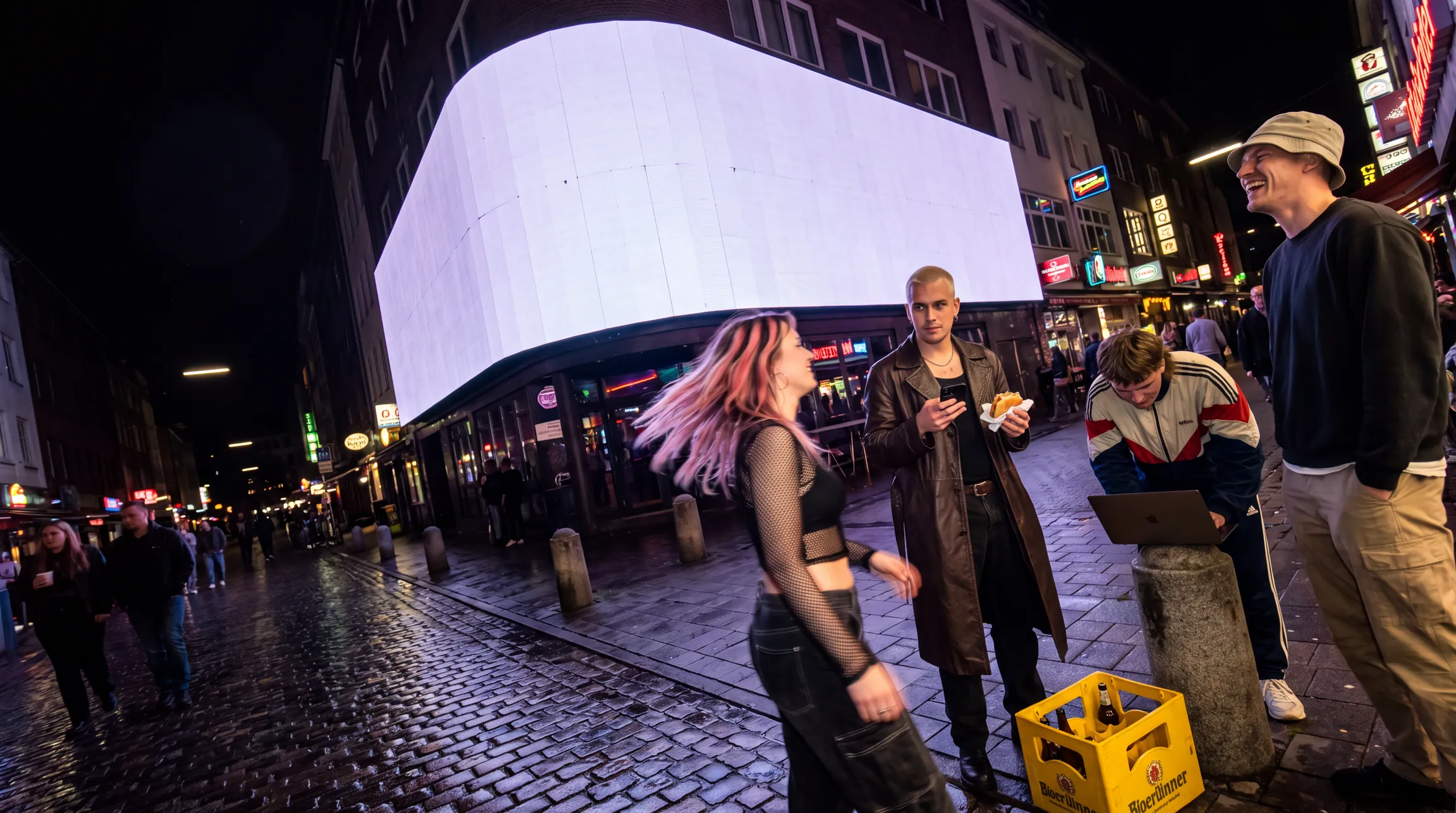

Two landmark screens made for 3D, in one city.
Ströer is turning Hamburg into its landmark-screen city: The Lighthouse, a corner of more than 530 m² built for anamorphic content on the Reeperbahn, and The Whale, a 342 m² LED wall at the central station. Around them, the street networks are being renewed under stricter rules. Below: the screens that suit a 3D billboard, who sells them, the rules and when to launch.
The Hamburg out-of-home market
Germany’s out-of-home market is growing fast. Nationally, gross advertising revenue passed €3 billion for the first time in 2024, up 12.7%, and digital out-of-home grew 19% to reach 43% of the total (Fachverband Aussenwerbung figures, reported by LebensmittelPraxis). Ströer, the largest operator, grew its national out-of-home revenue 5% to €691 million in the first nine months of 2025, with digital at €267 million (retail-news.de).
Hamburg is where the big screens are going. In August 2026, the city re-awarded its public-space advertising rights to Wall (JCDecaux group) and DSM Deutsche Städte Medien (Ströer group) until the end of 2041, subject to approval by the city parliament (City of Hamburg). Wall’s share covers 2,200 transit shelters with 1,710 analog and digital City Light Posters; Hamburg had Europe’s first digital 2 m² displays on public land in 2015 (invidis). Ströer forecasts that revenue from The Whale at the central station alone will exceed its total city-level DOOH revenue nationwide (invidis).
Screens that suit a 3D billboard in Hamburg
The Lighthouse, Spielbudenplatz, Reeperbahn
Ströer and blowUP mediaThree large LED displays around a round corner, more than 530 m², plus over 300 m² of ambient screensBuilt around the corner for anamorphic 3D; Ströer calls it Germany’s first immersive DOOH screen, bookable from mid-September 2026 (invidis)
The Whale, Hamburg Hauptbahnhof
Ströer and blowUP mediaIndoor LED wall, 342 m², 38 x 9 m, 10 mm pixel pitch; 10-second slots, up to 20 plays an hourMarketed as 3D; Daktronics says the view from the platforms suits forced-perspective effects; about 500,000 passersby a day (LEDinside)
Public Video Giant Screens, Hauptbahnhof
StröerIndoor LED screens up to 24 m²Carried AIDA’s animated 3D campaign in 2022 (CruiseMapper)
Public Video City Towers
StröerPortrait LED columns, 3.25 m² each, at high-traffic outdoor sitesStröer says objects can float free on them and 3D illusions are possible (CruiseMapper)
Digital City Light Posters
Wall (JCDecaux)2 m² panels on 2,200 sheltersNot a corner surface: simple depth effects at eye level, and the city-wide reach (invidis)
3D campaigns Hamburg has already seen
- AIDA Cruises (2022): an animated 3D cruise ship floating in waves, with water that seemed to spill out of the screen, on the City Towers and the Giant Screens at the Hauptbahnhof. It launched on 15 August 2022, ahead of the Hamburg Cruise Days (CruiseMapper).
- Zespri (2023): a forced-perspective campaign with the animated Kiwi Brothers breaking out of large DOOH screens in Düsseldorf, Hamburg and Munich, planned by Mindshare and ScreenOnDemand (Horizont).
Both ran on screens that were not built for 3D. The Lighthouse is.
Who sells the space
- Ströer: the Public Video Giant Screens and City Towers at the Hauptbahnhof, other stations, malls and outdoor sites, plus U-Bahn infoscreens such as Gänsemarkt (CruiseMapper).
- blowUP media (Ströer group): landmark screens, co-developer of The Whale and The Lighthouse (invidis).
- Wall (JCDecaux group): the transit shelter contract, renewed for 15 years in 2026 (invidis).
- DSM Deutsche Städte Medien (Ströer group): co-holder of the city’s public-space advertising rights to the end of 2041 (City of Hamburg).
Rules to know before you brief
All three come from the city’s new advertising contracts (City of Hamburg):
- Digital, but fewer: a new digital installation on public land is only allowed if analog installations are removed at a ratio of 1 to 1.5. Up to 170 sites could disappear, depending on district permits.
- Light and motion: digital installations under the city contracts switch off at night, shine less brightly to protect insects, and must not show garish or distracting effects. A 3D film for these screens has to stay calm.
- Federal lighting rule: the upcoming rule protecting animals and plants from artificial light (§ 41a of the Federal Nature Conservation Act) will also apply to existing digital installations.
When to launch in Hamburg
- 01
OMR Festival, in May: 70,000 attendees in 2026, mostly marketers and brand decision-makers; the 2027 edition runs from 3 to 5 May at Hamburg Messe (OMR).
- 02
Hamburg Cruise Days, in August: AIDA timed its 2022 3D campaign to the event (CruiseMapper).
- 03
Reeperbahn Festival, in September: Europe’s largest club festival takes over the street where The Lighthouse stands; the 2027 edition runs from 15 to 19 September (Reeperbahn Festival).
A 2D video gets seen. A 3D one gets filmed.
Same screen, same media budget. A flat video plays like every other ad. Anamorphic 3D seems to leave the screen, so people stop, film it and share it.
From your media plan to a moment people film.
You bring the screens and the brand. We bring the idea, the 3D and the delivery, and we keep it simple for you from the first call to the day it goes live.
See your brand break the screen.
Tell us about your next campaign. We come back with a concept built for your screen and your brand: the idea, the twist, and how it plays out. Free, and yours to keep.
No commitment. If you would rather talk it through first, book a call and we look at your plan together.
The messages we get once the screen goes live.
“Thank you, the team loves it”
Brand marketing · EMEA
“Really great work, thanks a lot”
Social lead · UK
“Thanks again, it looks amazing”
Brand content · HQ
“Congratulations on a job exceptionally well done”
Nathalie Dubois · Head of Brand Marketing, Media & Comms Western Europe
“Great job, thank you”
Campaign lead · DACH
Everything you need to know.
The Lighthouse on the Reeperbahn was built around a corner for anamorphic 3D, with more than 530 m² of LED. The Whale at the Hauptbahnhof is the indoor alternative: 342 m², seen from the platforms, at a station with about 500,000 passersby a day. The choice depends on the idea and the audience.
No Hamburg operator publishes rates for The Lighthouse, The Whale or its other screens, so the media is quoted per screen and per date. The 3D film depends on how many screens and formats it has to fit. We quote both once the screens are chosen.
Yes. We can handle the media buying with the operators, so the screens are chosen for the creative and the budget stays under control. If you already have a media agency, we deliver the 3D film to their plan.
Yes, under the city's advertising contracts. A new digital installation on public land is only allowed if analog ones are removed at a ratio of 1 to 1.5. Digital screens switch off at night, shine less brightly and must not show garish or distracting effects.
Yes. We create both flat and 3D versions and adapt them to every screen and media owner in your plan, whether that's one flagship billboard or dozens across markets. The technical back-and-forth is our job, not yours.
The creative is a separate line, but it never requires you to buy more media. You're making the impressions you've already paid for work harder: the same screens start generating organic reach on their own.
Ideas and early visuals can use AI. The final 3D is built by our own team, because a real screen with real people in front of it does not forgive approximation.