


Anamorphic screen: what it is, sizes, resolution and how content is made
An anamorphic screen is an ordinary LED screen playing 3D content built for one viewpoint. The shapes that work, size, resolution and price, and how anamorphic content is made.
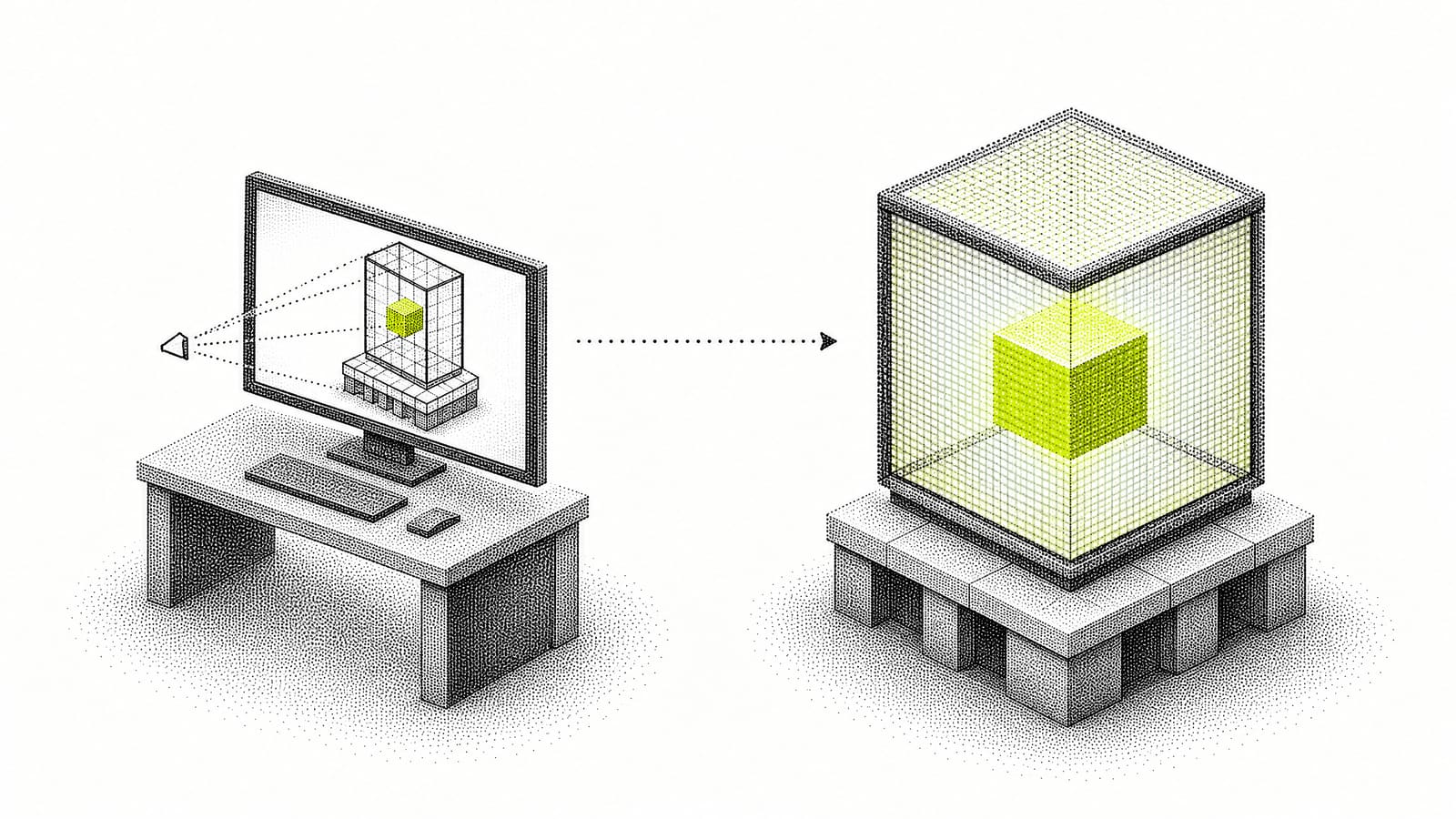
What is an anamorphic screen?
An anamorphic screen is an ordinary LED screen that plays anamorphic content: a 3D scene rendered for one viewing spot, so objects seem to come out of the screen. There is no special 3D hardware inside. The depth lives in the content, built for the exact shape of the screen and the place where people stand.
For the optical trick itself, read how anamorphic billboards work.
Anamorphic screen meaning: cinema or advertising?
In home cinema: a wide projection screen
In a home theater, an anamorphic screen is a wide “scope” projection screen, usually 2.39:1, often still sold as 2.35:1. An anamorphic lens in front of the projector stretches the picture to the full width, and every format keeps the same height: installers call it constant height, as Residential Systems explains. If that is what you need, talk to a home theater installer. The rest of this page is about advertising.
In advertising: an LED screen showing anamorphic 3D
In out-of-home advertising, an anamorphic screen (or anamorphic LED screen) is a digital screen playing content rendered to look three-dimensional from one spot. As the LED maker Planar puts it in its guide to naked-eye 3D: “the 3D effect is the result of the content, not the display itself.”
So there is nothing to buy that makes a screen anamorphic, whatever some vendors suggest. It is not stereoscopic 3D either: stereoscopic LED displays need special hardware and glasses. An anamorphic screen needs no glasses and no hologram, only the right file seen from the right place.
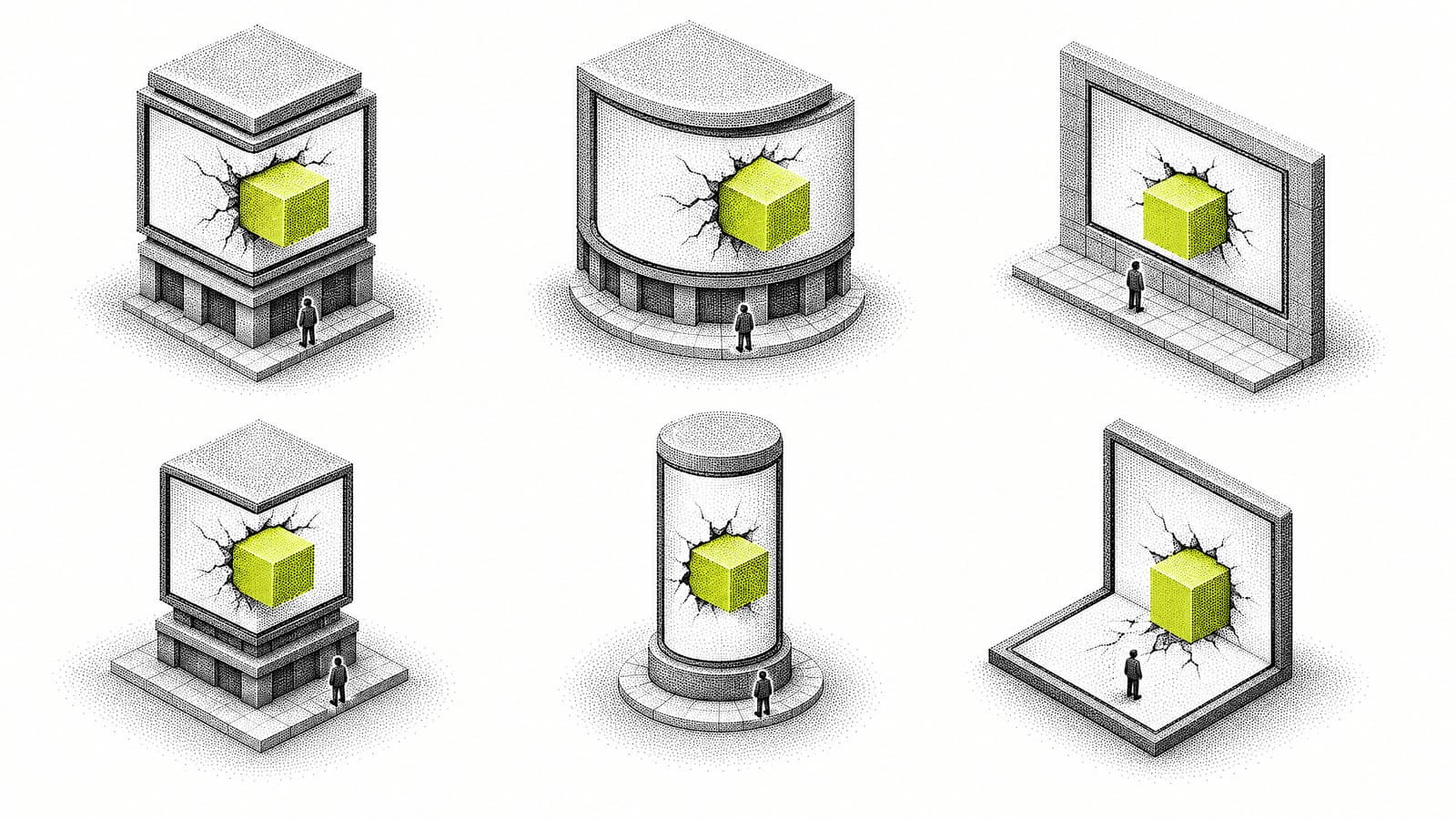
Anamorphic screen shapes
Any LED surface can take anamorphic content. The shape decides how the illusion is built and where people must stand.
- L-shaped corner screens. Two faces meet at an angle, and the building becomes the box. In 2025, Orange Barrel Media switched on an L-shaped screen on the Sunset Strip in Los Angeles, designed specifically for anamorphic campaigns, with a main face of 5.8 x 33.5 meters and a second screen on its underside.
- Curved screens and rounded corners. The Shinjuku cat ran in 2021 on Cross Shinjuku Vision, an LED board on the rounded corner of a building above Shinjuku Station in Tokyo.
- Flat screens. Most of the inventory you can book.
- Cubes and boxes. An anamorphic LED cube, or LED box, is seen from more than one side. Ocean Outdoor’s The Cube, a glass cube suspended inside Battersea Power Station in London, carries screens on three sides.
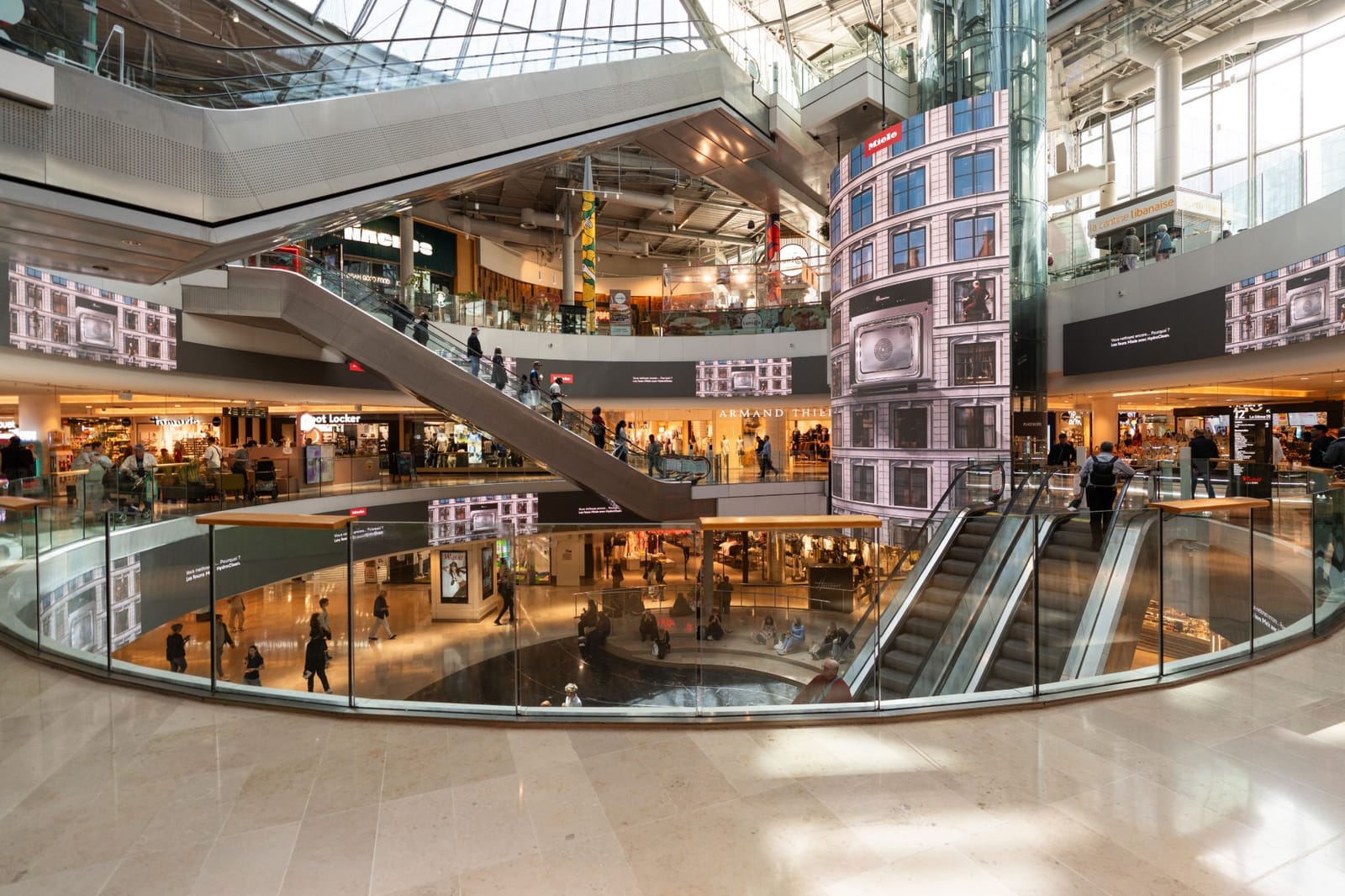
- Cylinders and rings. The image wraps around a column or runs along the balconies of an atrium.
- Multi-face walls and LED floors. The floor adds a ground plane between the screen and the viewer.
| Shape | How the illusion is built | Viewing zone | Watch out for |
|---|---|---|---|
| L-shaped corner | The faces become two walls of a box | Narrow, facing the corner | The seam, sync between faces |
| Curved | The scene wraps along the curve | One side of the curve | Exact radius, panel gaps |
| Flat | A frame drawn inside the image | Wide, in front | The frame must read from afar |
| Cube or box | Each face is one side of a volume | The main approach | Which face plays which file |
| Cylinder or rings | The image wraps around the space | The main approach | Escalators, rails, blind spots |
| Wall and floor | The floor extends the scene forward | Close, in front | People walk on the floor |
Corner, flat and curved screens are compared in our guide to corner screen vs flat screen.
Anamorphic screen size and viewing distance
There is no minimum size for an anamorphic screen. What matters is size compared with viewing distance, and the pixel pitch.
Pixel pitch is the distance, in millimeters, between the centers of two LED clusters. Samsung’s rule of thumb is about 8 feet of viewing distance per millimeter of pitch. The Sunset Strip screen uses Daktronics panels at a 6 mm pitch, and Cross Shinjuku Vision is a 6 mm board too. By that rule, both look clean from about 48 feet (15 meters), which suits a crowd across a street. A mall atrium or an LED floor is seen from much closer, so it needs a finer pitch.
A big screen seen from far away holds the effect over a wider zone; a small screen seen up close has a tight sweet spot.
What makes a good anamorphic LED display, beyond size:
- Brightness, contrast and wide viewing angles. Planar lists all three.
- No bezels. The frames of an LCD video wall cut through the perspective.
- Tight seams and synced faces on corners, cubes and curves.
Anamorphic screen resolution, ratio and frame rate
Resolution: work face by face
Large screens rarely use standard sizes. Ocean Outdoor’s UK spec list includes Piccadilly Lights at 5490 x 2160 pixels and the Bradford Media Wall at 4800 x 918. On multi-face sites, each face can have its own pitch, so the same physical size can be a different number of pixels.
Anamorphic content is rendered at the exact pixel size of each face, from the media owner’s pixel map. What to ask a media owner is listed in our guide to DOOH specs for 3D content.
Anamorphic screen ratio
In cinema, anamorphic means a ratio: 2.39:1. In advertising, there is no anamorphic ratio. The ratio is whatever the screen is: about 5.2:1 for the Bradford Media Wall, about 2.5:1 for Piccadilly Lights, 9:16 for a portrait mall panel.
Frame rate
Render at the rate the screen plays: usually 25 fps in the UK and Europe, often 30 fps in the US, sometimes 60 on premium screens. Converting later causes judder, and a stutter breaks the depth.
Anamorphic LED display price
We do not sell or install screens, so here is how the price of an anamorphic LED wall is built, not a number.
What drives the price:
- Size, in square meters of LED.
- Pixel pitch. Samsung warns that a finer pitch will almost certainly cost more. Match the pitch to the viewing distance, no finer.
- Indoor or outdoor. Outdoor panels need daylight brightness and weather protection.
- Shape. Corners, curves and cubes need special cabinets, flexible modules or custom engineering, as Daktronics did for the Sunset Strip screen.
- Structure, installation, permits and running costs: power, maintenance, selling the airtime.
For a real anamorphic LED display price, ask LED manufacturers and a local integrator to quote your site. A brand rarely buys the screen: it rents time on one. Our 3D billboard cost guide separates the creative, the media and the screen.
What is anamorphic content?
Anamorphic content is video, sometimes a still, rendered for one screen and one viewpoint, with the perspective distorted on purpose. On a monitor, the file looks stretched and skewed. On the real screen, from the right spot, it looks deep. It is delivered as a normal video file, usually MP4 in H.264, at the screen’s exact resolution.
Good anamorphic content makes people feel they are looking into a space behind the screen, until something inside it crosses the frame and comes toward them.
2D vs 3D anamorphic content
The terms are used loosely. In practice:
- 3D anamorphic content is a full CGI scene: modeled, lit, animated and rendered from a virtual camera at the viewer’s eye. Real volume, real shadows, parallax. The strongest effect, and the most production work.
- 2D anamorphic content places flat material (photos, graphics, type, footage) on planes inside a fake perspective box, skewed to the viewpoint. It is faster, reuses your 2D assets and gives a softer effect.
Anamorphic content video or FOOH?
Many “anamorphic videos” on social media are FOOH (fake out of home) films: CGI added to street footage after the shoot. An anamorphic video plays on a real screen that people in the street see.
How anamorphic content is created
- Survey the screen. Pixel map, real dimensions, corner angle or curve radius, gaps, and a photo from where people stand.
- Fix the viewpoint. The spot and eye height the scene is built for. Territory Studio places the eye line at the height of a viewer about five feet four inches tall, it told Maxon.
- Build the 3D model of the screen and its site, at real scale.
- Build the scene behind the glass, with the screen as the opening of a box.
- Render from the viewpoint camera and map it onto the screen model. For a three-sided curved screen in Singapore, a student team from Ansbach University of Applied Sciences baked its render onto a 3D model of the screen.
- Unwrap the screen model into the flat layout the media owner’s player expects.
- Check in the viewpoint photo, then on the real screen if a test is allowed.
From an approved brief, this takes us 3 to 4 weeks, with two rounds of changes included. Week by week: 3D billboard production.
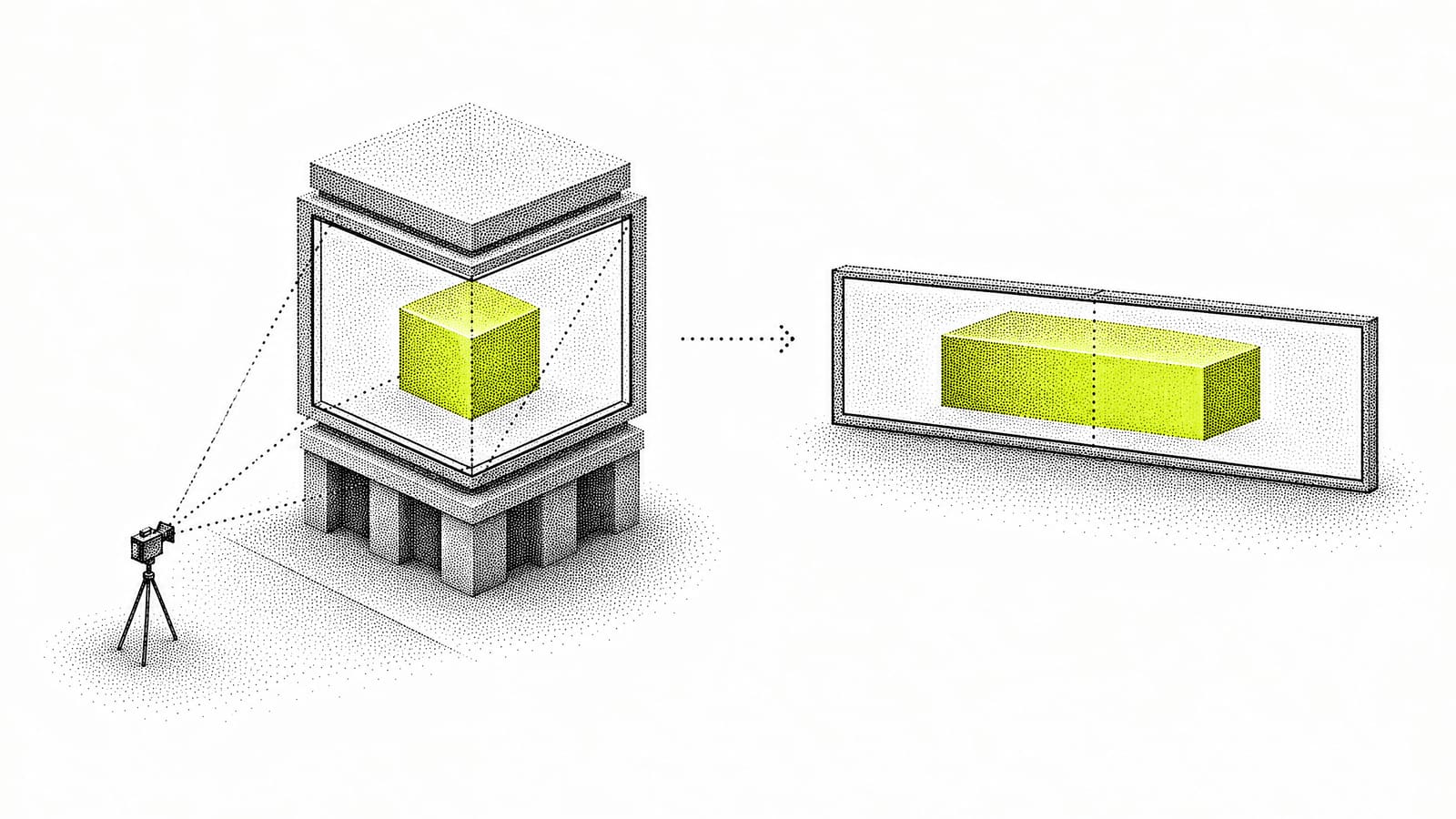
Why the 3D model of the screen matters
The model links the render to the real pixels. If the corner angle is a few degrees off, or a panel gap is missing, the edge of the virtual box lands in the wrong place and the depth collapses.
When Ocean Outdoor launched DeepScreen, its 3D format, in 2021 on eight screens in seven UK cities, it came with templates that recreate the size and curvature of each screen, Billboard Insider reported.
Free “anamorphic screen 3D models” for Blender are good for learning the trick. A paid campaign needs a model built from the media owner’s pixel map and real measurements.
Tools: Blender, Cinema 4D, Unreal Engine
There is no dedicated anamorphic software. Studios use standard 3D tools:
- Blender: free, and covers modeling, animation, camera projection and rendering.
- Cinema 4D with Redshift: used on Territory Studio’s Volvo EM90 billboards.
- Houdini: liquids, smoke and particles.
- Unreal Engine, Unity or TouchDesigner: real-time engines that cut render time.
- Nuke or After Effects: compositing and the unwrap.
The software is the easy part. The real viewpoint, the current template and a version for every screen are the hard part.
What does an anamorphic content creator do?
An anamorphic content creator, usually a 3D studio, turns a screen and a brief into files the media owner accepts: the idea, the CGI, the adaptation to each screen, the specs and the delivery.
Before you hire one, ask:
- Have they delivered on real screens? Ask for footage shot from the street, and from the side.
- Do they handle versions, languages and media-owner approval?
- Can the same 3D scene feed a social cut?
We are one of these studios. Across 150+ campaigns in 14 countries, we have adapted work to 750+ screens. Our anamorphic billboard service, 3DOOH, shows how we work.
Who buys anamorphic content?
- Brands, for launches and moments that need to be seen, filmed and shared.
- Agencies, creative or media, who sell the idea and need a production team behind it. They often use a studio in white label.
- Media owners with 3D-ready screens, like Orange Barrel Media’s Sunset Strip screen or Ocean’s DeepScreen network, who need content that shows advertisers what the screen can do.
One idea on a cylinder, rings, walls and an LED floor
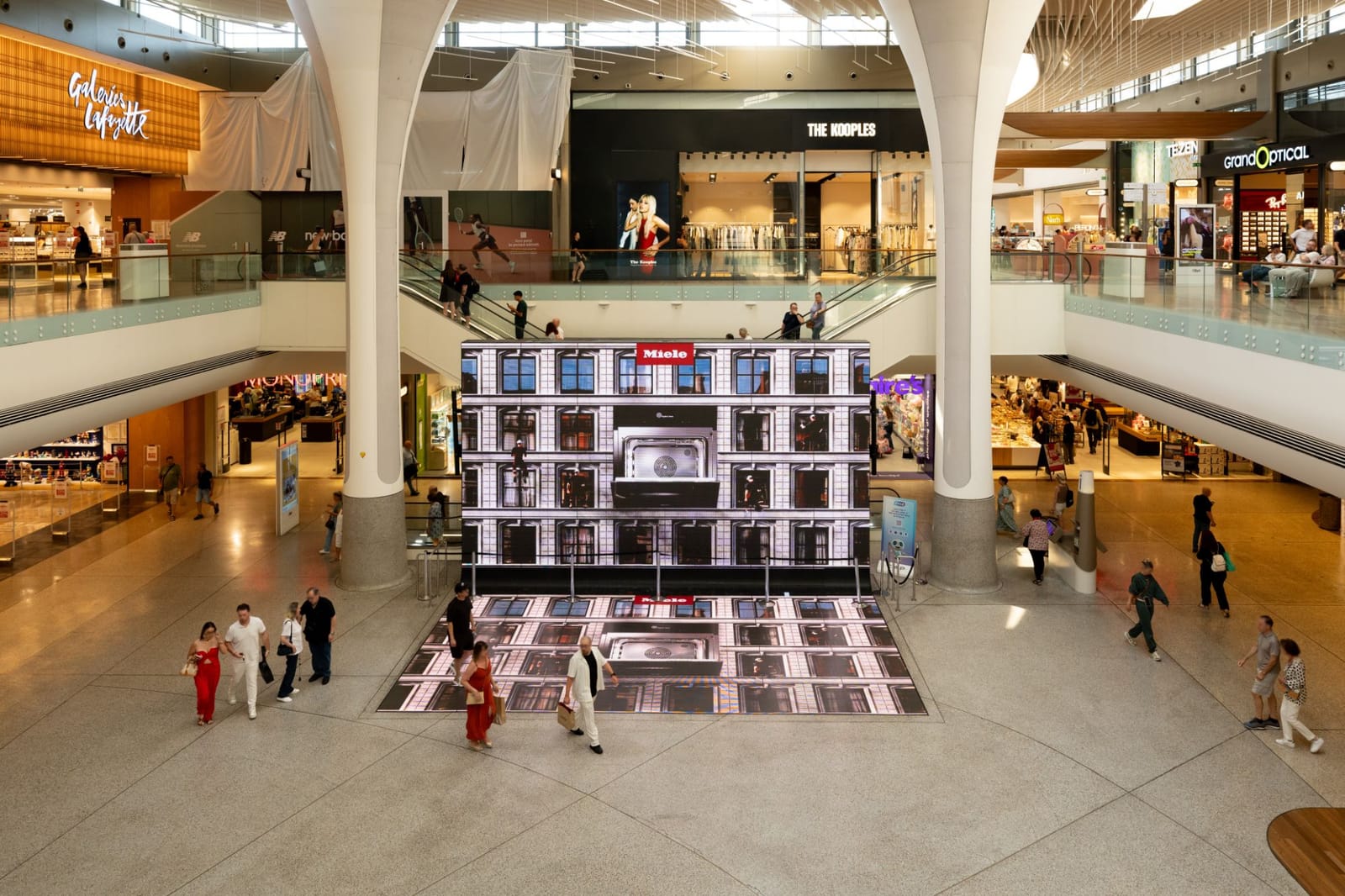
For the launch of Miele’s HydroClean oven, we built one CGI idea: a European facade that behaves like an oven. It ran on 81 screens in 76 cities, 4 countries and 5 languages, with more than 300 versions.
Those screens covered most of the shapes on this page. At Westfield Les 4 Temps, the film wrapped the cylindrical Digital Dream and ran on the ring screens of the atrium. At Cap 3000 near Nice, it played on an LED wall and on the LED floor in front of it. Each screen got its own version for its layout, resolution and frame rate, and screens with blind spots got one with nothing important placed there.
FAQ
Can any LED screen show anamorphic content?
Almost any. The brand of the panels does not matter. Brightness, contrast, viewing angles, a pitch that suits the viewing distance and clean seams do.
Does anamorphic content work on an LCD video wall or a projector?
With limits. LCD bezels cut through the perspective, so a flat design seen straight on works better there. Projection mapping can carry the same trick on a facade.
Can I reuse anamorphic content on another screen?
Not as it is. Each screen needs its own render. The idea, the models and the animation carry over, which is why each extra screen costs less than the first.
How much does anamorphic content cost?
There is no fixed price. It depends on the number of screens and formats, the resizing and the scene. The projects we are built for usually land around €40,000. The details are in how much a 3D billboard costs.
Does anamorphic content need sound?
Rarely. Most DOOH screens are silent, so the moment must work without sound. On Miele’s French plan, only Cap 3000 had it.
Have an LED screen in mind?
Send us the screen through contact: the media owner, the site, the spec sheet if you have it, and a photo from where people stand. We tell you what anamorphic content that screen can take, how the illusion will look from the street, and what it costs. Not ready to brief? Ask for a free concept for your screen.