What is DOOH? Digital out-of-home meaning, examples and how it works
DOOH stands for digital out-of-home: ads on screens in public places. What it means, how loops and programmatic buying work, how it is measured, and real DOOH examples.
What is DOOH?
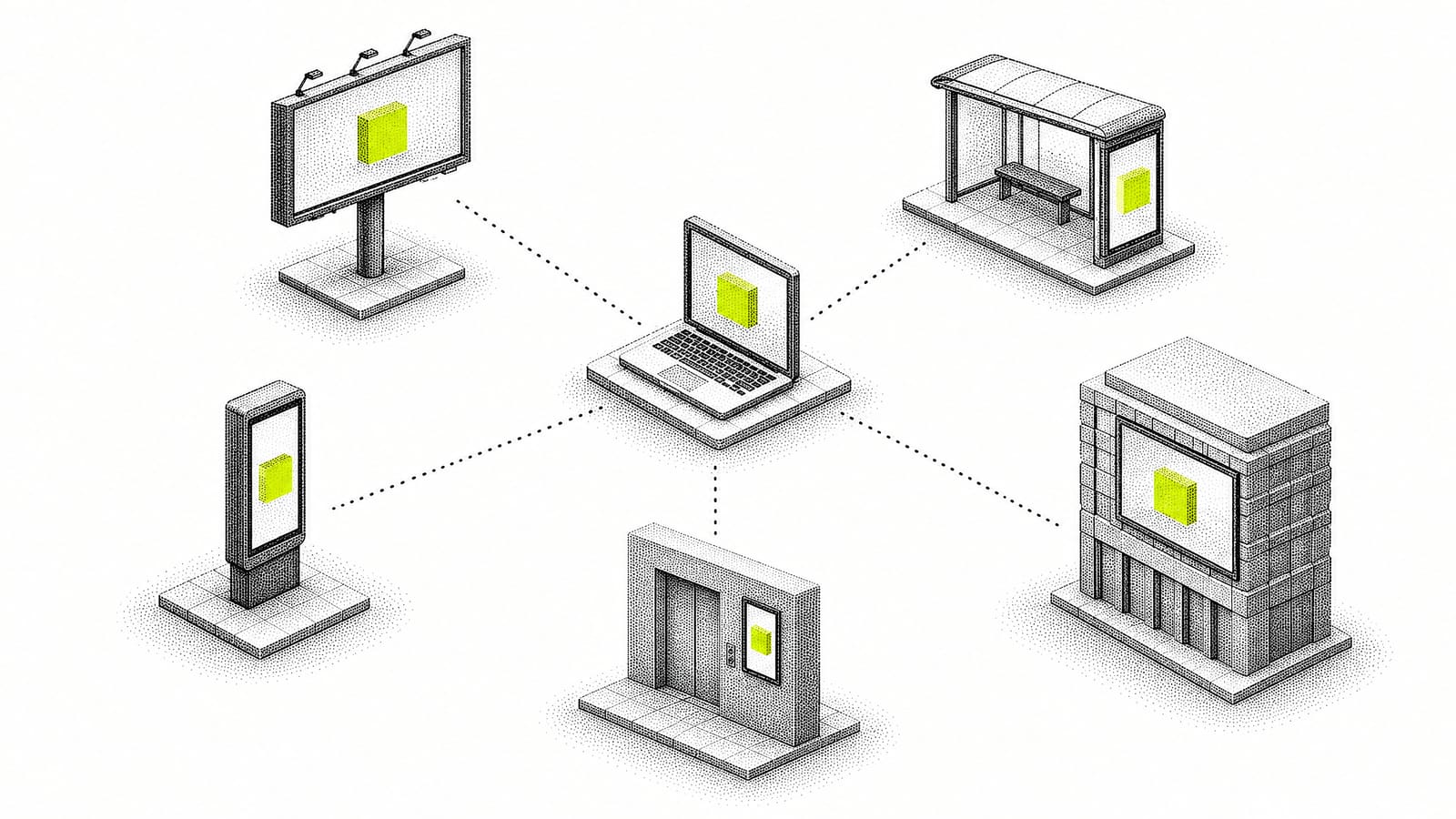
DOOH stands for digital out-of-home: advertising shown on digital screens in public places, from roadside billboards and bus shelters to station, airport, mall and building screens. Unlike a printed poster, a DOOH screen plays files, shares its airtime with other advertisers in a loop, and can change the ad by hour, place or audience.
The IAB, the US trade body for digital advertising, defines DOOH as “digital media used for marketing purposes outside of the home” (IAB, December 2024). The same document lists what DOOH is not: ads on phones and laptops, in-app ads, TV watched away from home, and static billboards, even with a QR code on them.
DOOH is a large and growing share of outdoor advertising. In the US, digital made up 36.3% of a record $9.46 billion out-of-home market in 2025, up 10.5% on the year, according to the OAAA, the US out-of-home trade body (MediaPost). In the UK, digital made up 67% of a record £1.44 billion in 2025, according to Outsmart, the UK industry body.
DOOH meaning: full form and related acronyms
The DOOH full form is digital out-of-home. Out-of-home (OOH) is every ad you meet outside your home: billboards, bus shelters, station posters, taxi tops. The “D” says the face is a screen, not paper or vinyl. “Digital OOH” and “digital billboards” usually mean the same thing.
| Acronym | Stands for | What it means |
|---|---|---|
| OOH | Out-of-home | All advertising outside the home, printed or digital |
| DOOH | Digital out-of-home | OOH on screens: files, loops, scheduling |
| pDOOH | Programmatic DOOH | DOOH bought through automated platforms, by audience and impression |
| 3DOOH | 3D digital out-of-home | Anamorphic creative that seems to come out of a DOOH screen |
| FOOH | Fake out-of-home | CGI films of impossible ads in real places, made for social media; nothing is installed (what is FOOH) |
A DOOH network is a group of screens sold together, usually by one media owner: every screen in a rail network, a mall chain or a city’s bus shelters. Because the network is managed centrally, one campaign can go live on hundreds of screens at once.
OOH vs DOOH: the difference
All DOOH is OOH. Not all OOH is DOOH. The difference between OOH and DOOH is the face, print or screen, and it changes how you produce, schedule, buy and measure.
| OOH (traditional) | DOOH (digital) | |
|---|---|---|
| Face | Printed paper or vinyl | LED or LCD screen |
| Creative | One still image per flight | Still, video, data-driven or 3D |
| Share of the face | Usually the whole face for the period | A slot in a loop, shared with other advertisers |
| Changing the message | Reprint and repost | Upload a new file |
| Scheduling | By week or month | By day, hour or trigger |
| Buying | Direct, by panel and period | Direct, or programmatic by impression |
| Proof it ran | Photos of the posted site | Play logs from the screen |
Print keeps one real strength: the face is yours for the whole period, with no loop to share. More in 3D billboards vs traditional billboards.
How DOOH works: screens, loops and proof of play
Every DOOH site has three parts: the display, a media player that stores and plays the files, and a content management system (CMS) that schedules what plays where and when.
The loop. A screen does not show one ad. It plays a sequence of ads that repeats all day. The IAB glossary gives this example: a six-minute loop with 11 to 15-second ad positions, repeated 10 times an hour, so each ad plays 10 times an hour (IAB DOOH glossary).
The slot. Your position in the loop, with a fixed length set by the media owner: 6 or 10 seconds on many networks, longer on some.
Share of voice. The part of the loop’s airtime you buy. One slot in a loop shared by six advertisers is a sixth of the airtime. A takeover is all of it.
Triggers. You can run only at rush hour, on weekdays, or when a condition is met. The IAB lists inputs such as weather, sports scores, showtimes and countdowns.
Proof of play. The screen logs every play. Proof of play (PoP) is the report that shows your ad actually ran. Ask for it on every booking.
DOOH screens: the main types
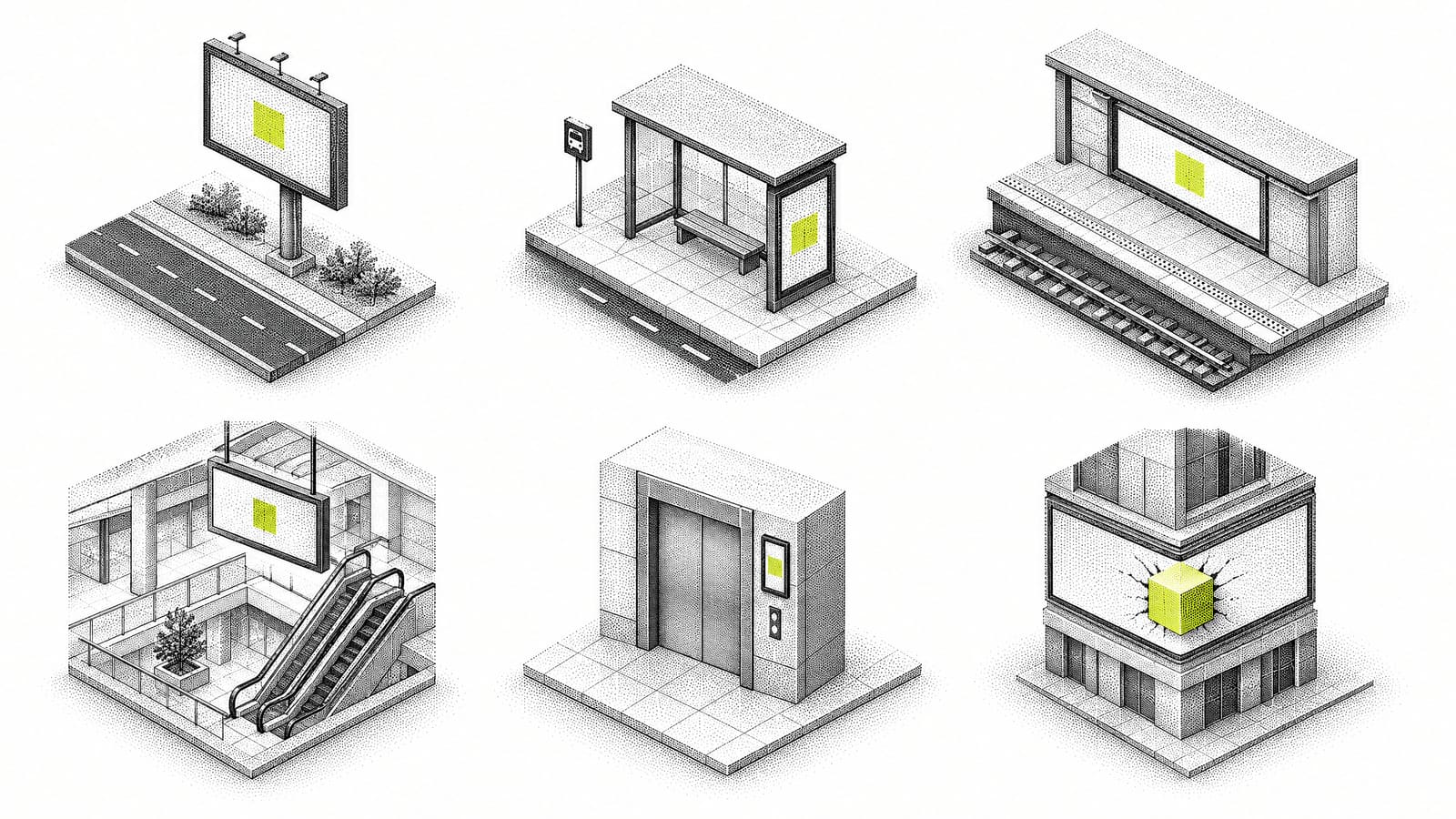
The IAB lists 11 venue categories, from transit and retail to gyms and doctors’ offices. For planning, six families matter. They differ in how long people look and whether motion is allowed.
Roadside digital billboards. Large screens beside highways and main roads, seen from a car. In the US, the industry code says standard-size roadside digital billboards show static messages only, outside established entertainment areas, and the OAAA says they typically rotate every 6 or 8 seconds.
Street furniture. Digital bus shelters, kiosks and city panels at eye level, often sold as networks.
Transit. Stations, metros, airports. People wait or walk slowly, so there is time for motion.
Retail and malls. Atrium screens, shopping-street screens, in-store displays. Close to the point of purchase.
Indoor place-based. Elevators, office lobbies, gyms, bars, cinemas. Small screens seen up close.
Landmarks and spectaculars. Facades, corner screens and giant curved screens in places like Times Square or Piccadilly Circus. Few, expensive, and the screens people film.
How DOOH is bought: direct vs programmatic
There are two ways to buy DOOH, and many screens are sold both ways.
Direct buying
You or your media agency book named screens with the media owner, for set dates and a set share of the loop. You know exactly where and when your ad plays, and you can run creative made for one screen.
Programmatic DOOH (pDOOH)
Programmatic DOOH is DOOH bought through software, the way online display ads are bought. In plain words:
- SSP (supply-side platform): the software a media owner uses to put its screens up for sale, with prices and availability.
- DSP (demand-side platform): the software a buyer uses to set the audience, places, times and budget, and to buy. The IAB notes it can be a DSP dedicated to DOOH or an omnichannel one.
- The deal: an open auction, a private marketplace for chosen buyers, or a guaranteed deal with fixed inventory and price.
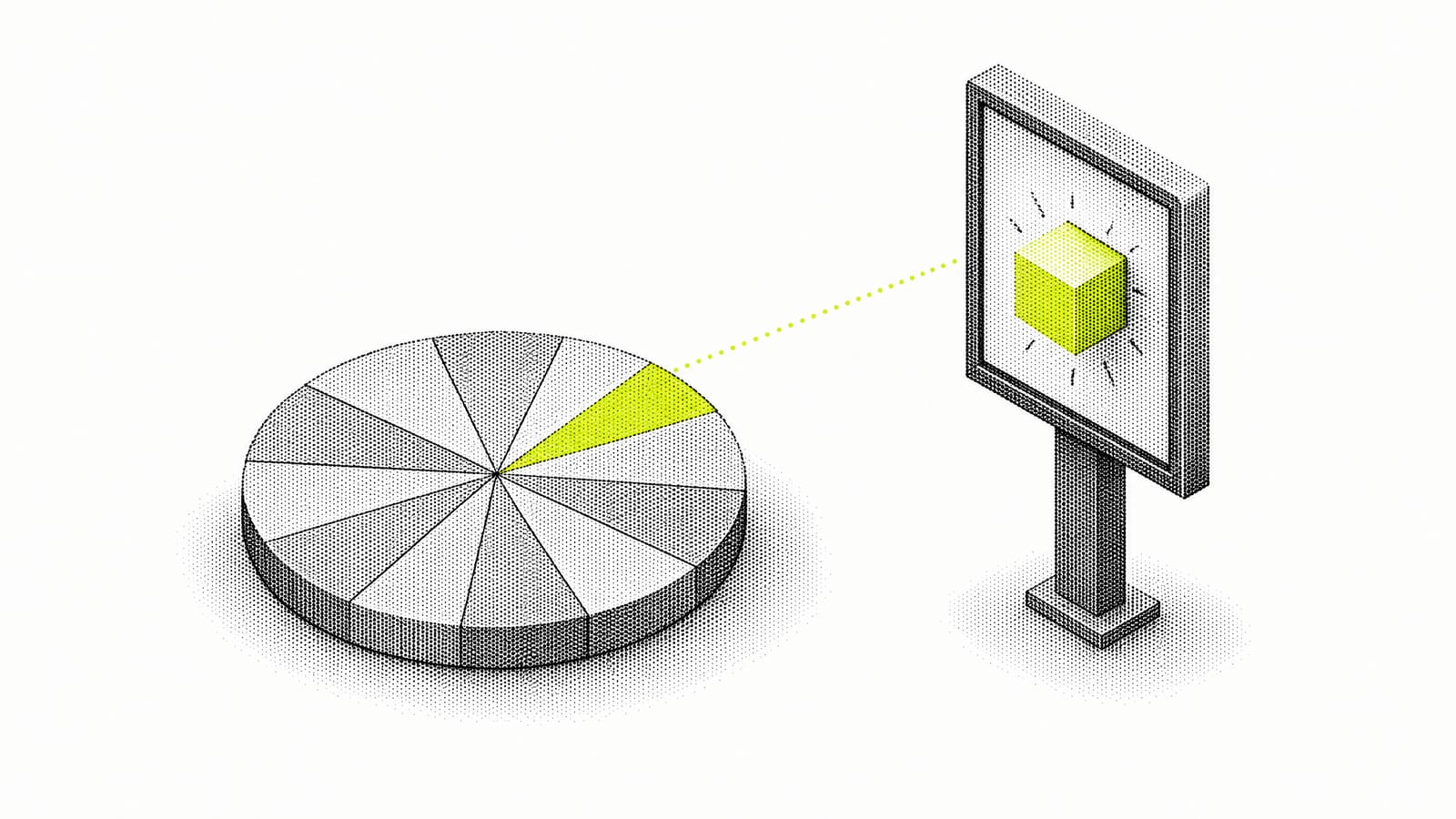
The audience multiplier. Online, one ad served is one impression. A street screen is seen by many people at once, so each play is multiplied by an estimate of how many people were likely to see it. The UK standard from Outsmart shows the math: if your ad plays 15 times between 8:45 and 9:00, and Route, the UK audience currency, estimates 150 impacts in that quarter hour, the multiplier is 10. With 300 impacts between 9:00 and 9:15, it is 20. Each UK screen has 8,064 multipliers: one per quarter hour, day of the week and month (Outsmart). You pay per thousand audience impressions (CPM), not per play.
Programmatic is growing but still a minority of spend. A World Out of Home Organization study aggregated by PwC put global programmatic DOOH at $1.34 billion in 2025, about 7% of DOOH spend, and 15.9% in the US.
DOOH vs pDOOH: which one?
| Direct DOOH | Programmatic DOOH | |
|---|---|---|
| You buy | Named screens, dates, share of loop | Audience impressions on screens that match your rules |
| Price | Rate card per screen or package, per flight | CPM, often in an auction |
| Control | Exact screens and times, takeovers possible | The platform picks screens within your rules |
| Best for | Landmarks, launches, creative built for one screen | Audience-led reach, tests, data triggers |
Our advice: buy 3D creative direct. An anamorphic film is built for the exact shape of one screen, so you need to know which screens will play it. If nothing is booked yet, KOSMO can handle the media buy: you keep control of the budget, and the screens are chosen to fit the idea.
How DOOH is measured: impressions, KPIs and brand lift
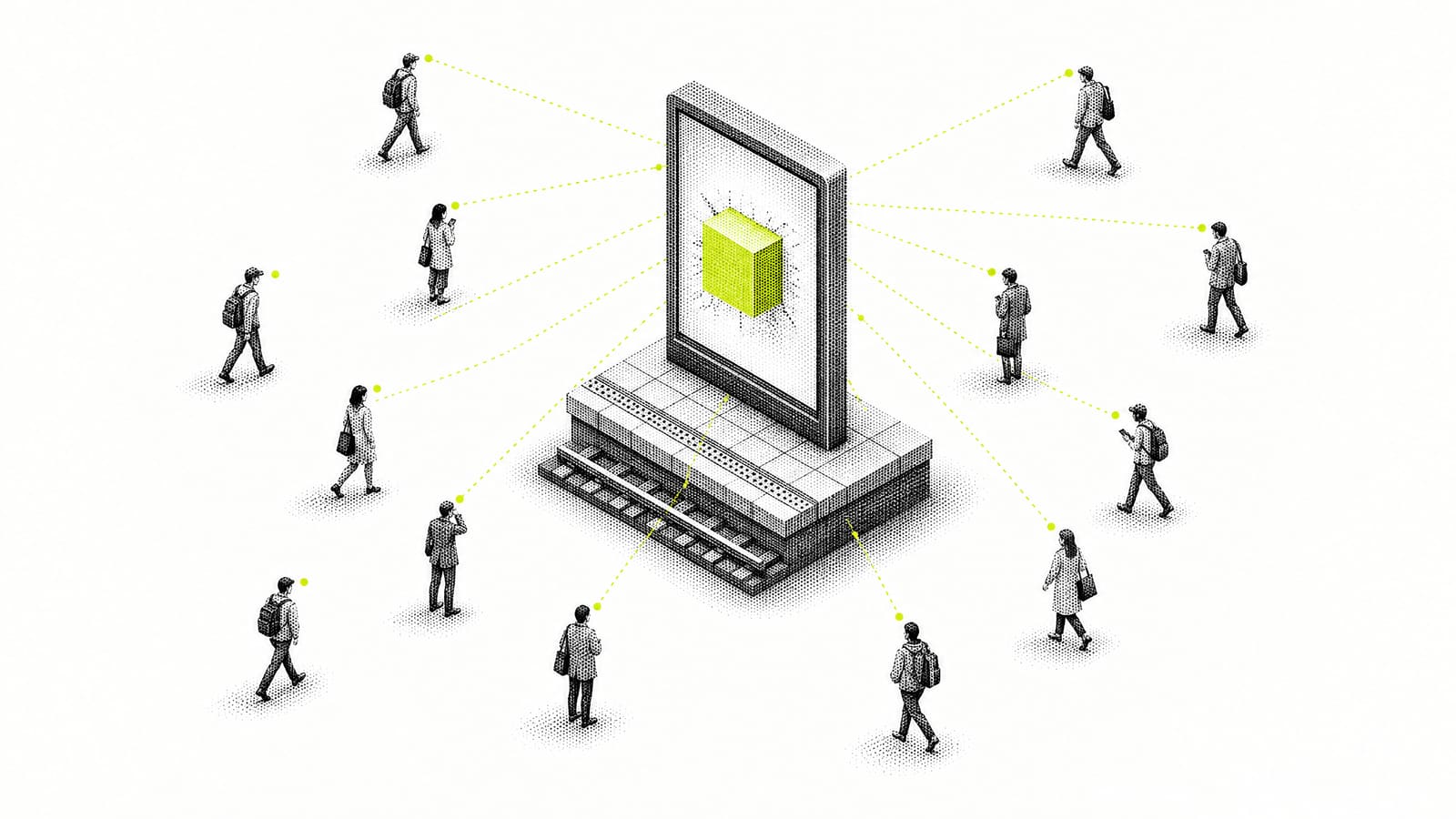
DOOH measurement works in three layers.
- Delivery. Did the ad play? Proof-of-play logs, per screen and per hour.
- Audience. Who could see it? Plays become audience impressions: in the IAB’s definition, people with an opportunity to see, adjusted for notice and dwell time and calibrated to the spot length. The figures come from audience currencies such as Geopath in the US and Route in the UK. They are models built from traffic and location data, not head counts.
- Effect. Did it change anything? That is where the KPIs come in.
| Goal | DOOH KPI | How it is measured |
|---|---|---|
| Awareness | Reach, frequency, ad recall | Audience data, brand lift survey (exposed vs not exposed) |
| Store visits | Visit lift | Mobile location data, exposed group vs control group |
| Online action | Branded search, site visits | Campaign areas vs control areas |
| Sales | Sales lift | Test and control stores or regions, or marketing mix modeling |
| Talkability | Videos, mentions, shares | Social listening by location tag, hashtag and brand name |
Audience methods differ by country and vendor, so compare CPMs only within the same audience currency. And define the control group of a lift study before launch.
Benefits and limits of digital out-of-home advertising
Benefits
- No skip button. It reaches people in the street, where no ad blocker works.
- It changes fast. A new file, not a new print run: swap an offer, change the language by city.
- It fits the moment. Dayparting and triggers put the message at the right hour or in the right weather.
- It scales. One idea can run on hundreds of screens in several countries.
- It allows motion. Video, data-driven and 3D creative, where the rules allow it.
Limits
- You share the screen. Your ad is one slot in a loop, seen for a few seconds.
- Rules restrict the creative. US roadside screens are static only, and most screens have no sound.
- Every screen is different. Specs vary by network and often by site, so a network campaign means many versions.
- Measurement is modeled. Impressions are estimates, not counts.
DOOH and retail media
The IAB says the line is blurring: the same screen in a store can count as DOOH in one campaign and retail media in another. What decides it is the data. When the retailer’s own data, such as purchase history or loyalty cards, drives the targeting and the sales measurement, it is retail media.
DOOH examples: campaigns that used the screen
The best DOOH examples use something a printed poster cannot do: live data, a camera, motion, depth.
British Airways, “The Magic of Flying” (OgilvyOne London, 2013). Digital billboards in Piccadilly Circus and on the M4 route to Heathrow ran other ads until a BA plane flew over. Then a child stood up and pointed at the real plane, and the screen named the flight and its origin, read live from the aircraft’s transponder data. It won two D&AD Yellow Pencils in 2014 (D&AD).
Women’s Aid, “Look At Me” (WCRS, 2015). A bruised woman on three Ocean Outdoor screens, launched at Canary Wharf on March 5, 2015. Facial recognition counted the people looking, and the bruises healed as more people looked, as Marketing Week reported. It won a Gold Lion in Outdoor at Cannes that year.
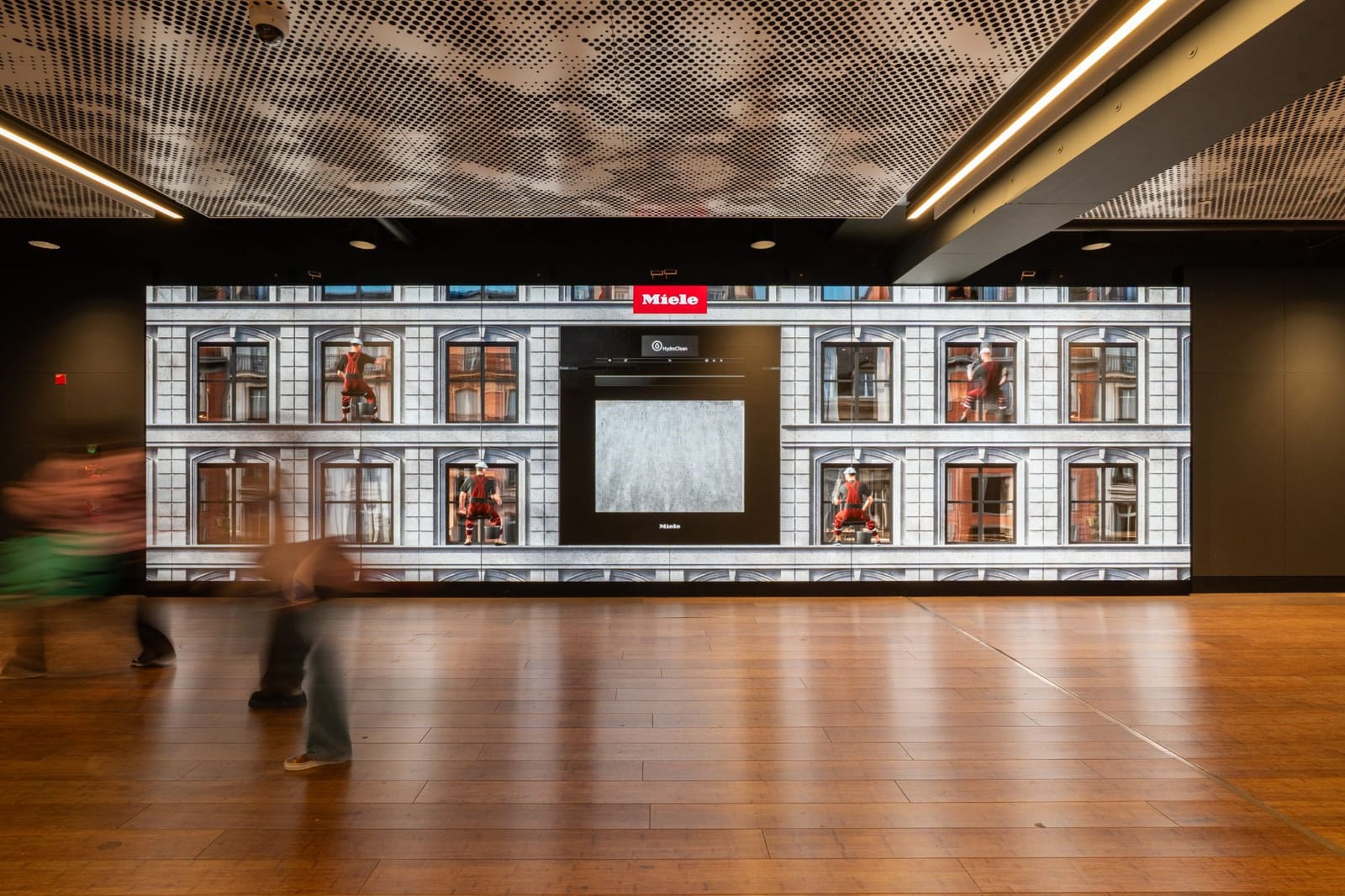
Miele HydroClean (KOSMO, 2026). One CGI idea for Miele’s self-cleaning oven: a European building that opens like an oven and cleans itself. It ran on 81 DOOH screens in 76 cities across France, Belgium, Luxembourg and the Netherlands, in 5 languages and more than 300 versions, mostly in 10-second slots in malls, stations and shopping streets.
3D DOOH. The Shinjuku cat in Tokyo is DOOH too, with anamorphic creative. See more famous 3D billboards by city, with the studios behind them.
DOOH creative: static, motion, data or 3D
Everyone in the loop gets the same screen and the same slot. The creative is the part you control.
- Static. One still image, the only option on most US roadside screens. One message, few words, the brand large.
- Motion. A short, usually silent film. People arrive mid-loop, so the first second has to work alone, with the brand visible from the first frame.
- Dynamic. A template filled with live data: weather, time, scores, the nearest store.
- 3D (anamorphic). A film built for one screen’s shape and viewpoint, so objects seem to leave the frame. It is the format people film and share. The illusion only works from one zone, and the novelty has worn off in big cities: the idea has to earn the attention. See what 3D DOOH is and our anamorphic 3D billboards.
DOOH ad formats, sizes and specs
There is no universal DOOH ad size. Landscape 1920 x 1080 and portrait 1080 x 1920 are common, large screens are often non-standard, and most networks take MP4 in H.264 for motion. Each media owner sets its own spec sheet, often per site. On Miele HydroClean, every screen got a version built for its exact layout, resolution and frame rate. Our guide to DOOH specs lists what to collect before production.
Miele’s media team drew lessons after launch that apply to any DOOH campaign: check each location before booking it, use only high-resolution screens, and run a control round on day one.
How much does DOOH advertising cost?
Bought direct, DOOH media is priced by location, share of loop and flight length; bought programmatically, by CPM. Creative is a separate budget. Our guide to DOOH advertising cost covers both.
DOOH companies: who does what
The names below are examples, not a ranking.
- Media owners own the screens and sell the time: JCDecaux, Clear Channel Outdoor, Outfront, Lamar, Ströer and Ocean Outdoor, plus many local operators.
- SSPs sell that inventory programmatically: VIOOH, Broadsign, Place Exchange, Hivestack.
- DSPs let buyers bid on it: DOOH specialists such as Vistar Media, or omnichannel platforms such as The Trade Desk.
- Measurement bodies set the audience currency: Geopath in the US, Route in the UK.
- Media agencies and OOH specialists plan and buy campaigns.
- Creative studios make the content. KOSMO is one of them, for 3D and CGI.
FAQ
Is DOOH the same as digital signage?
Not quite. Digital signage is any centrally managed screen network, including menus and information displays. DOOH is the part of it sold as advertising to brands.
Does a billboard with a QR code count as DOOH?
No. The IAB excludes static signs, QR code or not. A DOOH ad can carry a QR code, but check the rules: Lamar, for example, does not allow them on its digital billboards.
How long is a DOOH ad?
As long as the slot each media owner sets: often 6 or 10 seconds, sometimes 15 or 30. Miele HydroClean ran mostly in 10-second slots, plus 6 and 30-second cuts.
Do DOOH ads have sound?
Usually not, so the film must work without audio. A few sites have speakers: in Miele’s French plan, only the Cap 3000 screen near Nice played sound.
Is DOOH advertising effective?
It depends on the screens, the frequency and the creative. Its effect can be measured with brand lift and visit lift studies against a control group, so agree on the measurement plan before you book.
Planning a DOOH campaign?
Tell us about your campaign: the markets, the dates, the screens if you have them, and the product. We tell you which screens and formats fit, build the creative people notice, and can handle the media buy. Not ready to brief yet? Ask for a free concept for your screen and judge the idea first.