


Miele Japan on Shinjuku Wall 456: one 3D film for a 45.6-metre screen, resized for pillars and trains
Shinjuku Wall 456 is 45.6 metres long and 1.71 metres high. How we built one 3D film for Miele's AutoDos dishwashers that people walk along, then resized it for 39 pillar screens and the Yamanote Line.
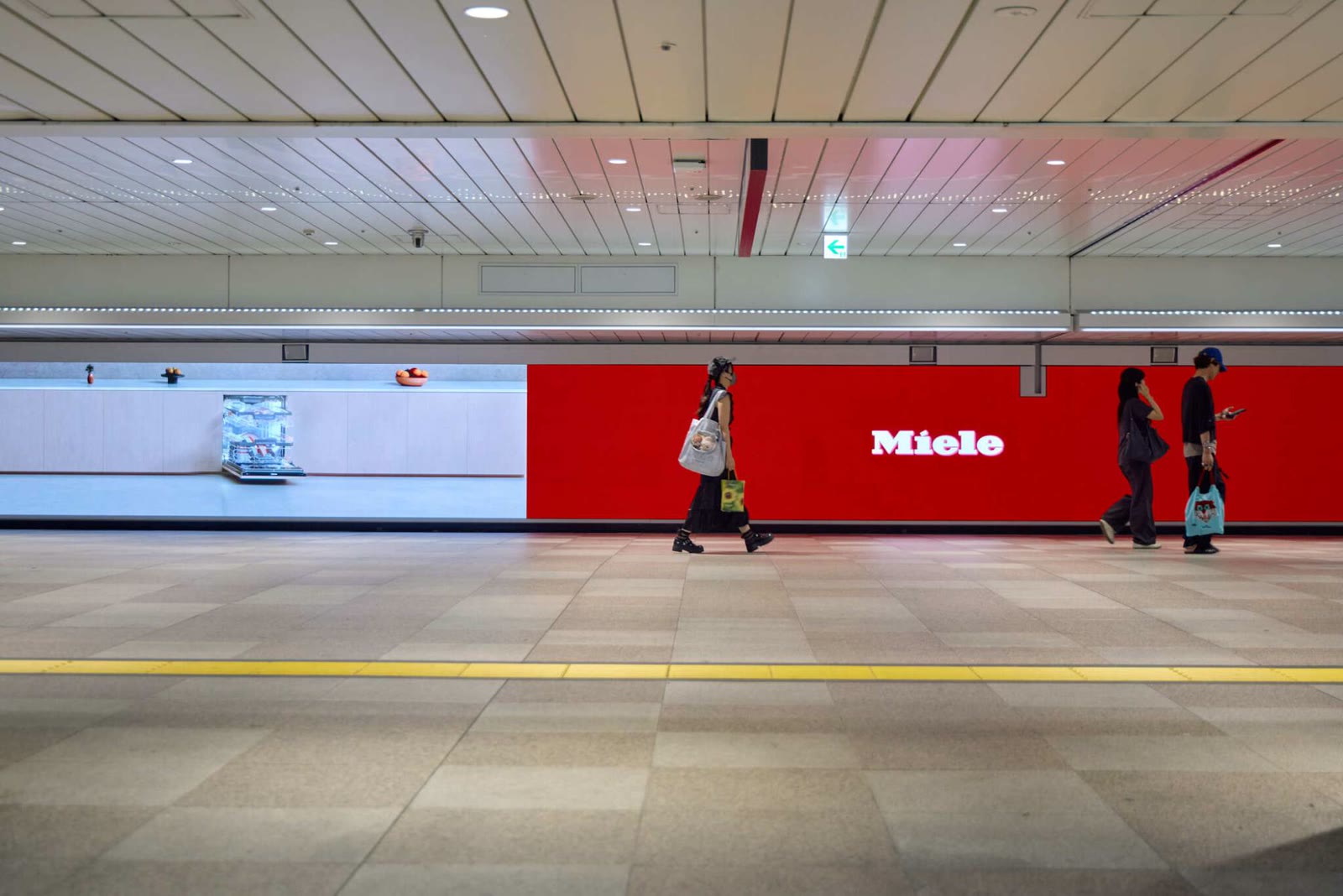
From 31 August to 6 September 2026, Miele Japan had the whole of Shinjuku Wall 456, the 45.6-metre LED wall in JR Shinjuku station, to launch its dishwashers with AutoDos. We made the 3D film for it: a single story that runs along the full length of the wall, then the same film resized for the 39 pillar screens of the passage and the screens of the JR Yamanote Line trains.
A screen you walk, not watch
Shinjuku Wall 456 runs along the East-West Free Passage of JR Shinjuku station, one of the busiest stations in the world. It is 45.6 metres long and 1.71 metres high, one of the largest LED screens in Japan, and it has been running since May 2021, with 39 J-AD Vision pillar screens and 16 sound points along the same walkway, per Panasonic and Advertimes.
In pixels, the canvas is 28,800 × 1,080: about 27 times wider than it is high. A standard HD frame covers one panel out of fifteen. Nobody sees the whole wall at once, and nobody stands in front of it: people walk past it, from either end, and catch the loop wherever it happens to be.
That changes everything about the creative:
- The story has to travel. Something has to move along the wall at walking pace, so the people in the passage follow it.
- Every frame has to work alone. Someone who looks up for two seconds, at any point of the 30-second loop, must still get it.
- The centre is the brand’s. People coming from both ends look towards the middle. That is where luxury brands put their logo on this wall, and where Miele’s went.
And the station has its own rules. JR’s guidelines for station media rule out anything that makes people stop, sudden loud sounds, flashing or extreme brightness, unhygienic or frightening images, and anything that could be mistaken for station signage. Miele’s global team, meanwhile, asked for “stopping power”. The film had to hold attention without ever blocking the flow.
The brief
Miele Japan was introduced to us by Miele’s Western Europe team, after our HydroClean campaign on 81 screens in four countries. The product was the G7984 dishwasher with AutoDos, which doses the detergent by itself from a PowerDisk, and the message was Miele’s superior quality and precision.
The media plan: Shinjuku Wall 456 with 100% share of voice, in-train screens on the JR Yamanote Line, the loop line that circles central Tokyo, and the J-AD Vision pillar screens of the passage, all for one week.
From four seasons to one PowerDisk
The first rounds explored several routes, from a Shinkansen idea to “Four Seasons”, one plate per season along the wall, so that anyone catching the screen mid-loop would understand. Miele’s global team steered the campaign towards the product itself: AutoDos, in line with Miele’s “Once a Miele, Always a Miele” platform.
Then came the real question from global: does the film truly use the extreme horizontal format? Our answer was a split screen built for the wall. Six panels with three dishwashers on the left, a permanent Miele logo block of three panels, 9.12 metres, in the centre, and the same six panels mirrored on the right. Global’s answer: “Loved it… great stopping power. Kudos.”

The film, scene by scene
The loop is 30 seconds: 21 seconds of CGI, then the end frames.
- A dark kitchen, Japanese tableware set out along the wall.
- Detergent powder pours along the whole length of the screen and buries the dishes. The super asks: 洗剤、その量でいい? (“Is that the right amount of detergent?”).
- The PowerDisk slides in and rolls along the wall, vacuuming up every grain.
- The lights come up on a pearl-beige Miele kitchen. The disk shrinks and becomes three.
- Three dishwasher doors open, the dishes fly into the racks, the disks jump into their compartments.
- The doors close, then reopen on a white glow and sparkling dishes.
- Two taglines, ついに訪れた。洗剤の投入から解放される日が。(“This could be the day you say goodbye to manual dosing.”) and Miele食器洗い機 洗剤自動投入AutoDos搭載 (“Miele dishwashers with AutoDos”), then the wall turns Miele red.
Making it hold at 28,800 pixels
Everything on the wall is 3D: lookdev in Blender, the powder simulation in Houdini, compositing in After Effects. At this scale, every detail is seen up close by thousands of people a day, so the brief came with rules, and each one shaped the film.
- Powder that reads as detergent. In the first frames, nobody could tell detergent from coffee or chicken stock powder. We tested three simulation approaches, then reworked the powder so it piles and falls instead of flowing like water, until it could only be one thing.
- Glasses under the powder. Glassware was a global mandate: eight to nine glasses among the 21 pieces in the foreground, wine and champagne glasses in a Riedel style. Rendering glass buried in powder looked too heavy at first. We solved it and kept them.
- Japanese tableware, by the rules. Arita ware as the reference, no metallic trims or over-glaze paint, deep dishes never facing up, and the Asian cutlery basket filled with chopsticks, spoons and small bowls, one of the product’s key features in Japan.
- Nothing on the floor. For hygiene, dishes could not sit on the ground. The tableware moved to a tea-ceremony stand, then to a legless white kitchen island.
- Sound for a station. Realistic sound design and no licensed music, ending on an ambient soundscape. The PowerDisk was not allowed to sound like ocean waves.
- A white glow, not a yellow one. The moment of truth, when the doors reopen, went from a warm glow to a clean white one, and the smoke went.
Before any texture, every shot went through grey. The animatic locks timing and staging, the simulation tests lock how the powder moves, the clay renders lock where every plate goes. Materials, light and the long final render only come after.

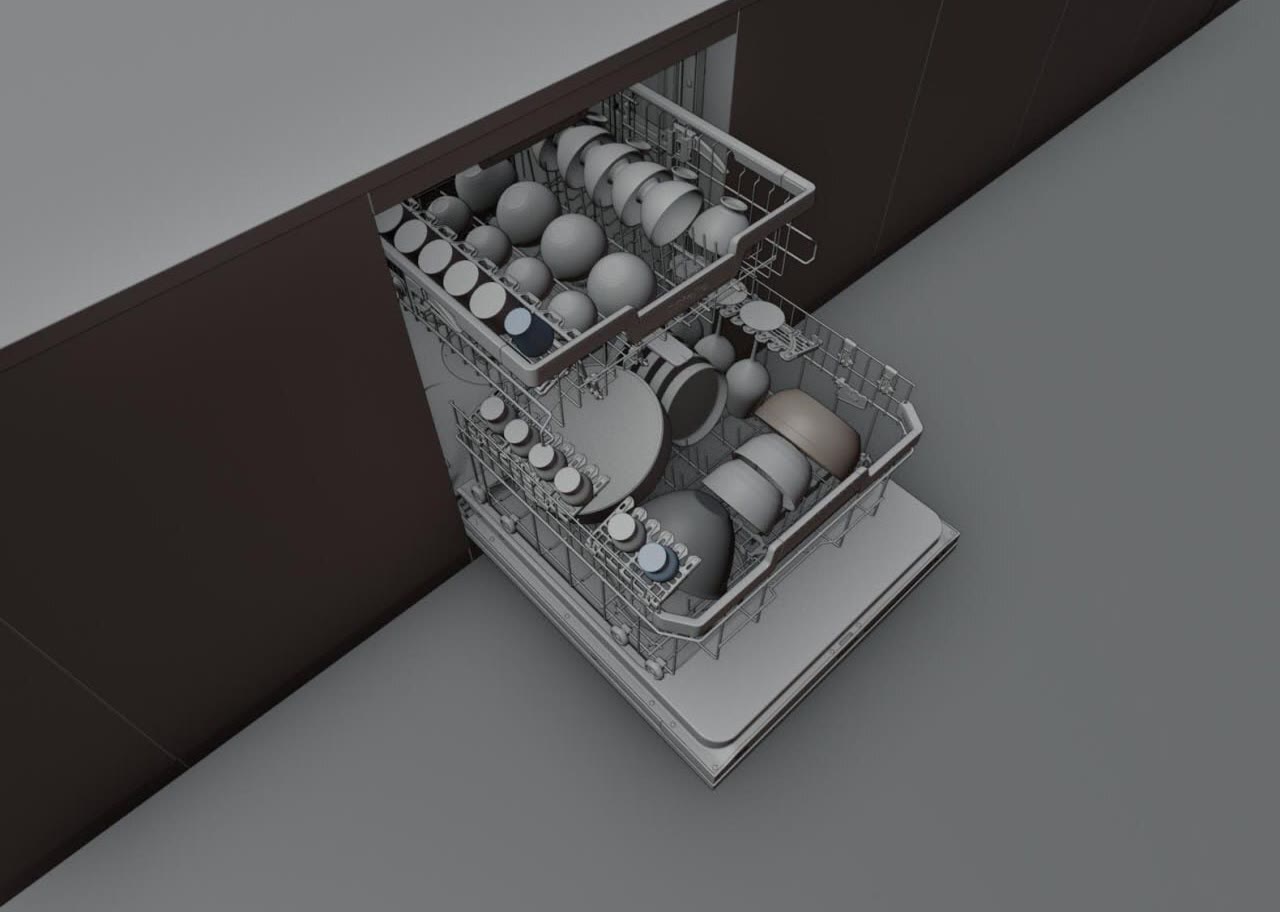
From kickoff on 4 June to final delivery on 4 August, the project ran two months, with the final render of the wall alone taking about 15 hours.
One film, three formats
The wall came first, and everything else was cut from it, so no scene had to be simulated twice.
Shinjuku Wall 456. The 28,800 × 1,080 master, delivered as 8K HEVC files at the bitrate and loudness the station’s system requires: six 30-second loops in a 180-second file, in Japanese and English.
J-AD Vision, 39 pillar screens. A 1,080 × 1,920 portrait version. One dishwasher instead of three, a shorter PowerDisk roll, the same timings, and the red logo synced with the wall, so the whole passage turns Miele red at the same second. On LCD, the end frame was shortened to avoid burn-in.
JR Yamanote Line. A 15-second version without sound, at 29.97 frames per second, for the in-train screens: three screens in a row above the windows and one above the door, all playing the same film. It is a crop of the wall render.
On the wall
The campaign went live on Monday 31 August and ran for seven days.
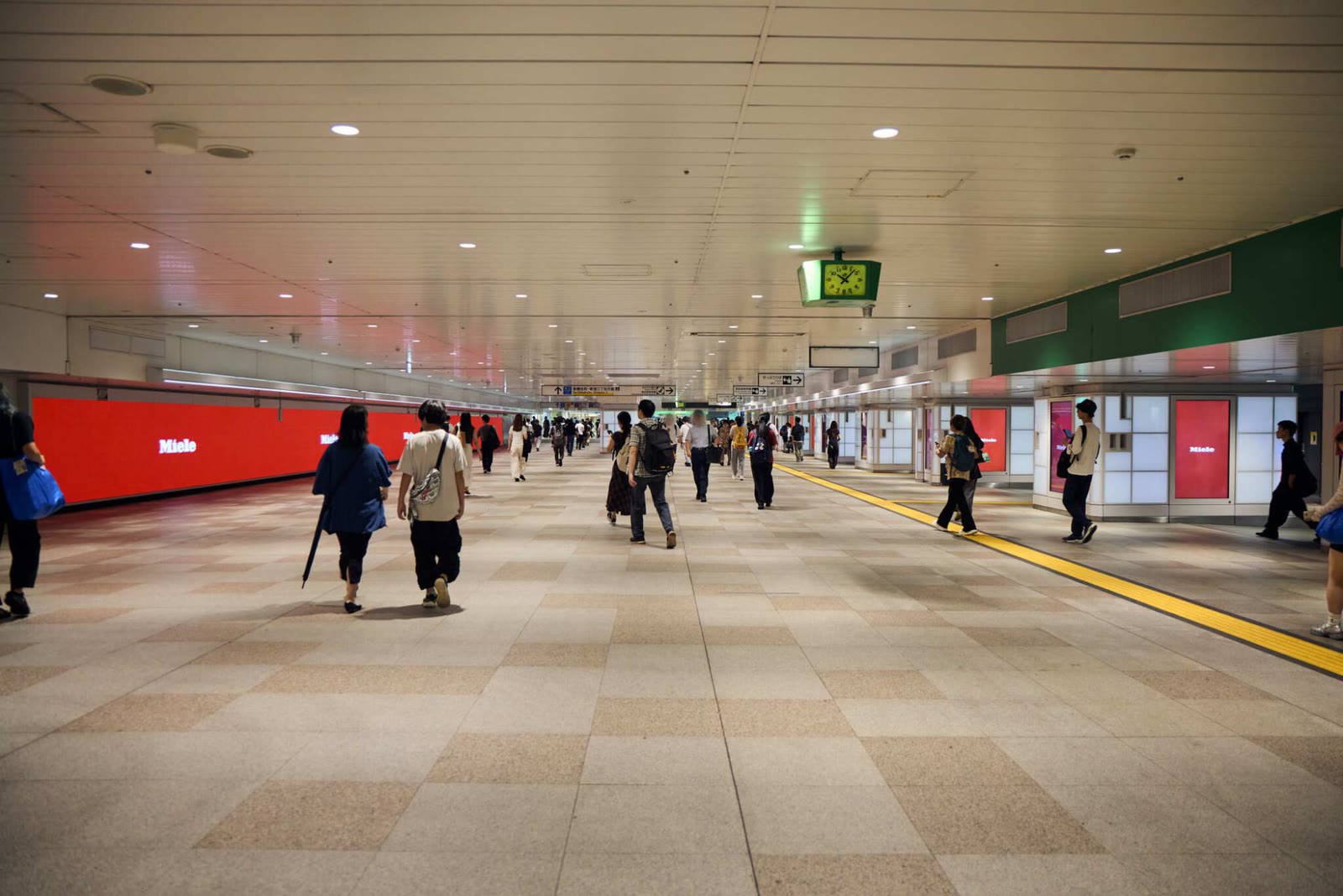
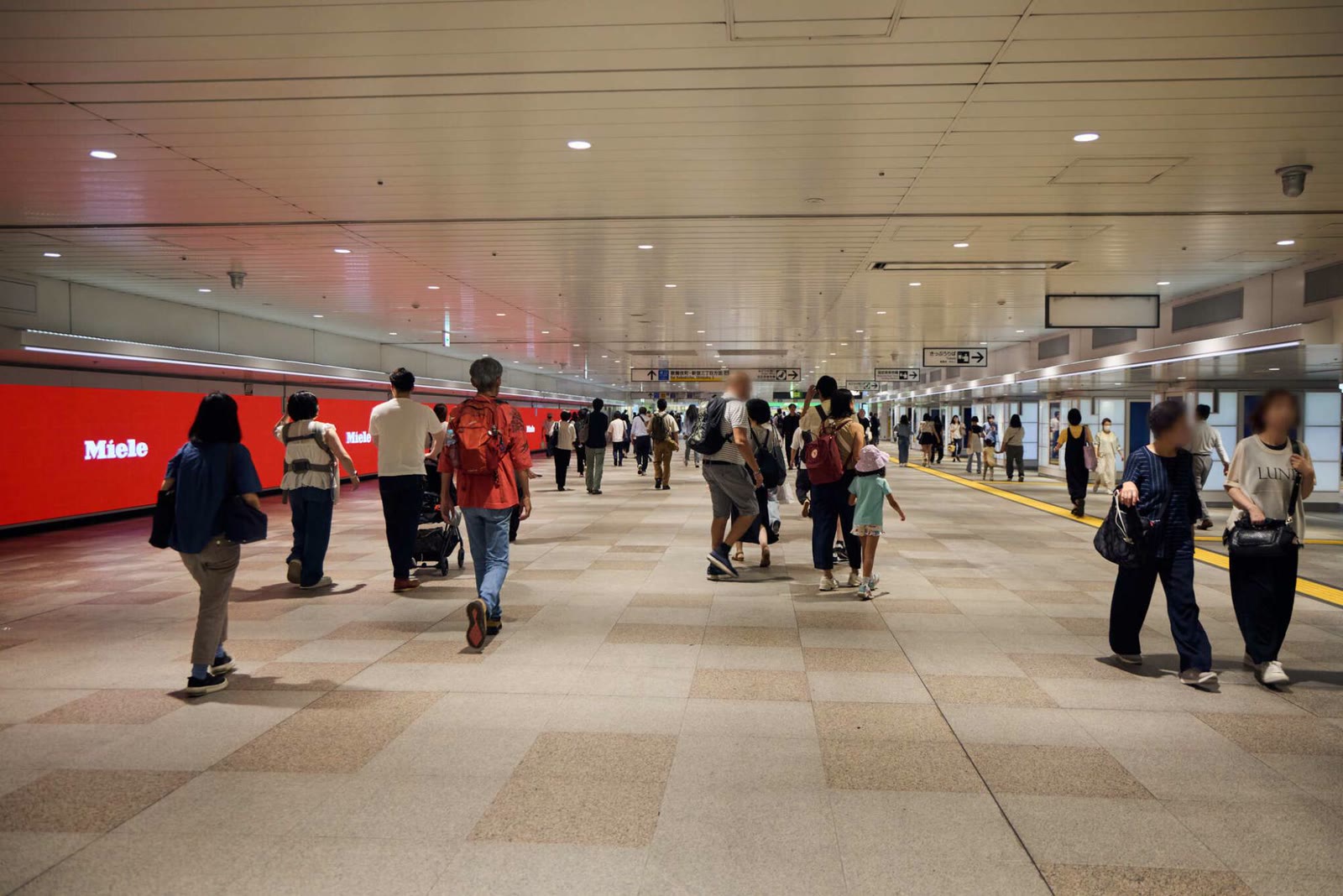
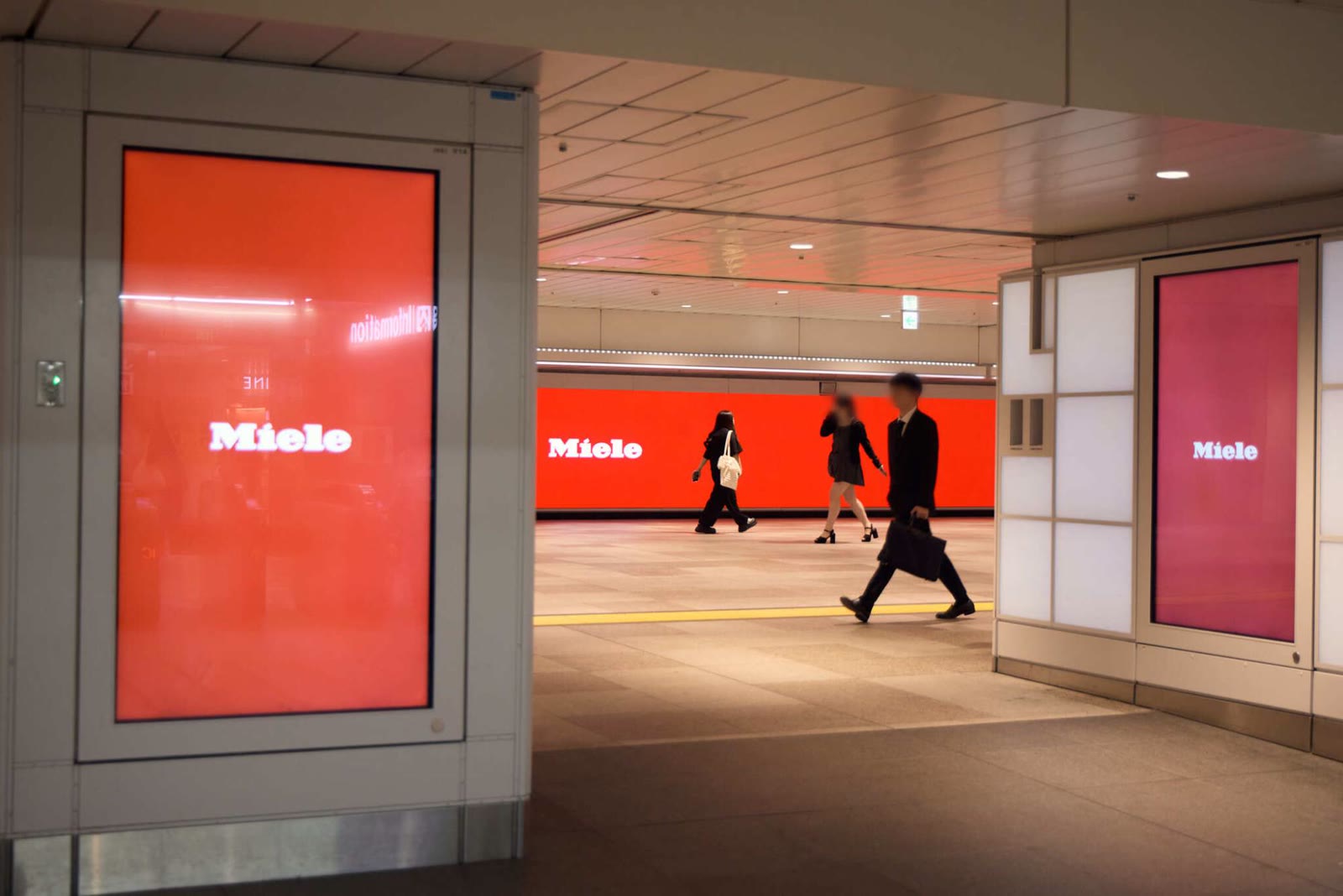
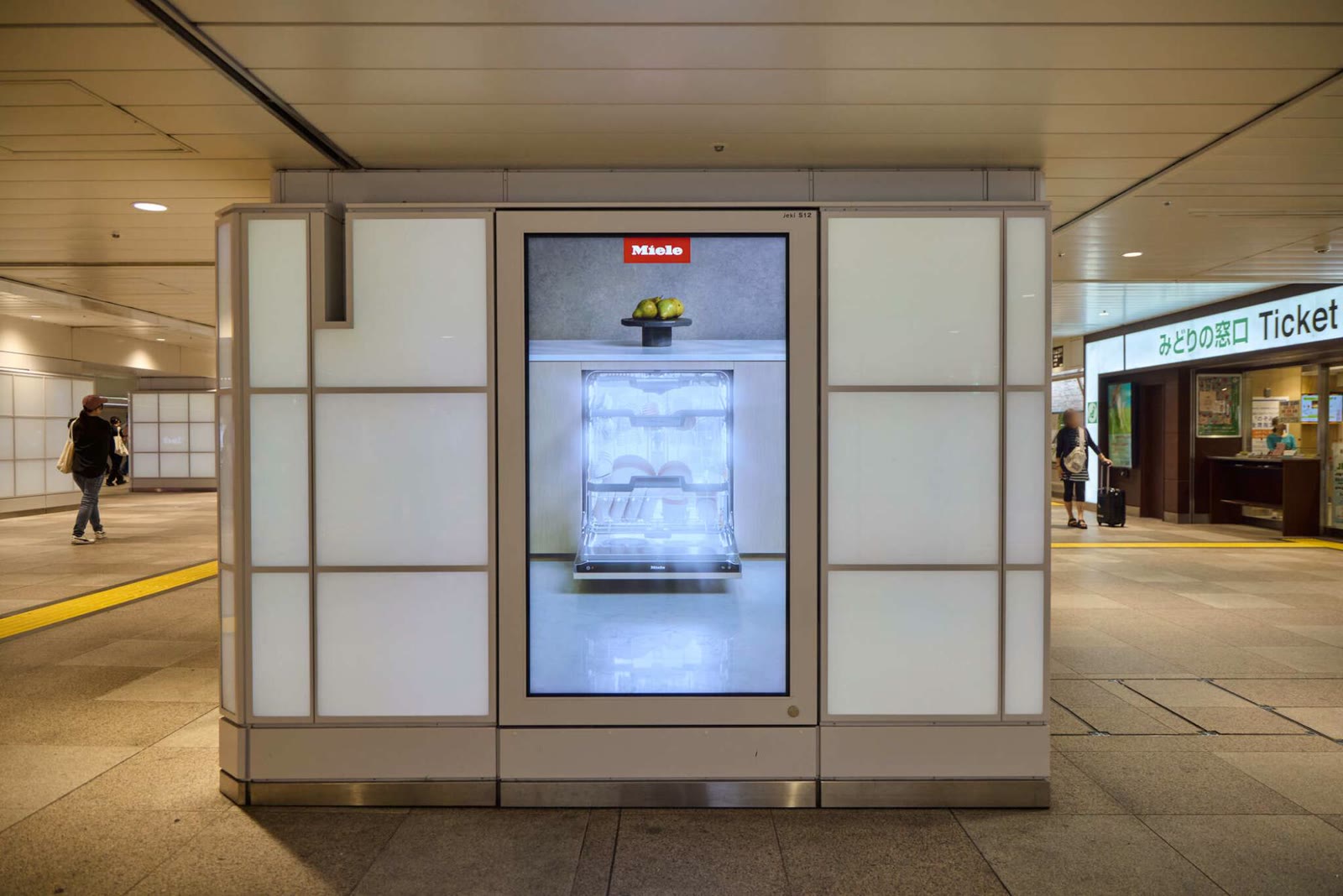
When the first videos came in, the Western Europe team that had introduced us wrote back: “What a great work! Love it!”
What we took from it
- Design for walking, not watching. On a 45.6-metre wall, the camera is the passer-by. The story has to move at their pace and make sense from any point.
- Give the centre to the brand. A permanent logo block in the middle of the wall did more for “stopping power” than any effect.
- Plan the crops before the simulation. Because the pillar and train versions were cut from the wall render, three formats cost one simulation.
- Treat the rules as the brief. Station guidelines, hygiene, tableware: each constraint made the film more precise.
Two Miele campaigns, two continents, the same approach: one CGI idea, built for the screens it runs on. The European one is in our HydroClean case study, and the difference between flat-screen and corner 3D is in our guide to anamorphic and forced perspective.
FAQ
How big is Shinjuku Wall 456?
45.6 metres long and 1.71 metres high, along the East-West Free Passage of JR Shinjuku station in Tokyo. For a film, the canvas is 28,800 × 1,080 pixels, about 27 times wider than it is high.
Can one 3D film run on different DOOH formats?
Yes, if the formats are planned before production. For Miele, the 45.6-metre wall film was reframed into a 1,080 × 1,920 portrait version for 39 pillar screens and a 15-second version for the Yamanote Line trains, all from the same render.
How long does a campaign like this take?
Two months for this one, from kickoff on 4 June to final delivery on 4 August 2026, including concept rounds, the powder simulation, the final render and the technical checks of the media owner.
A screen that does not fit a standard frame?
Send us the specs, and we will show you what the whole screen can do.